

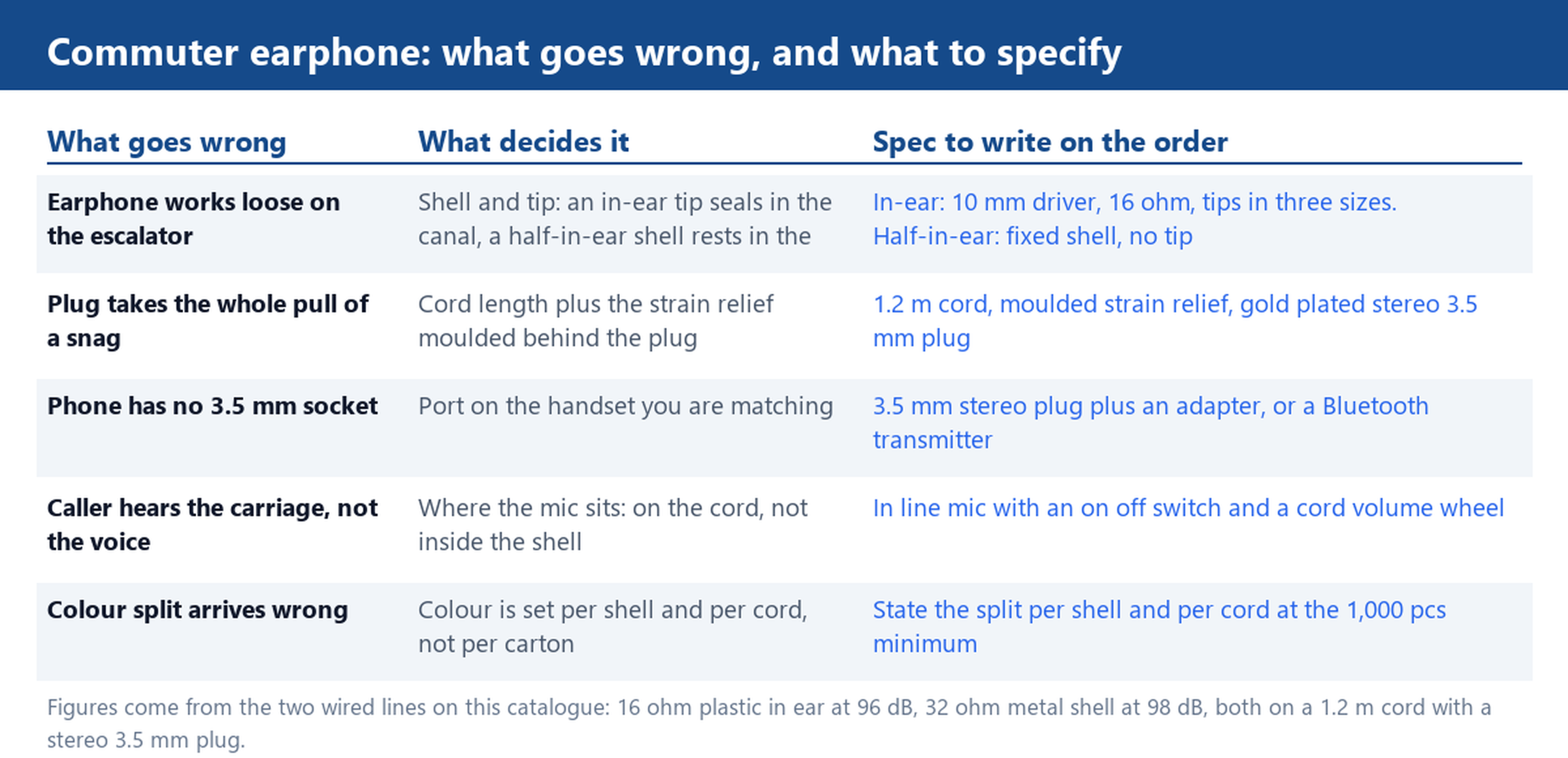
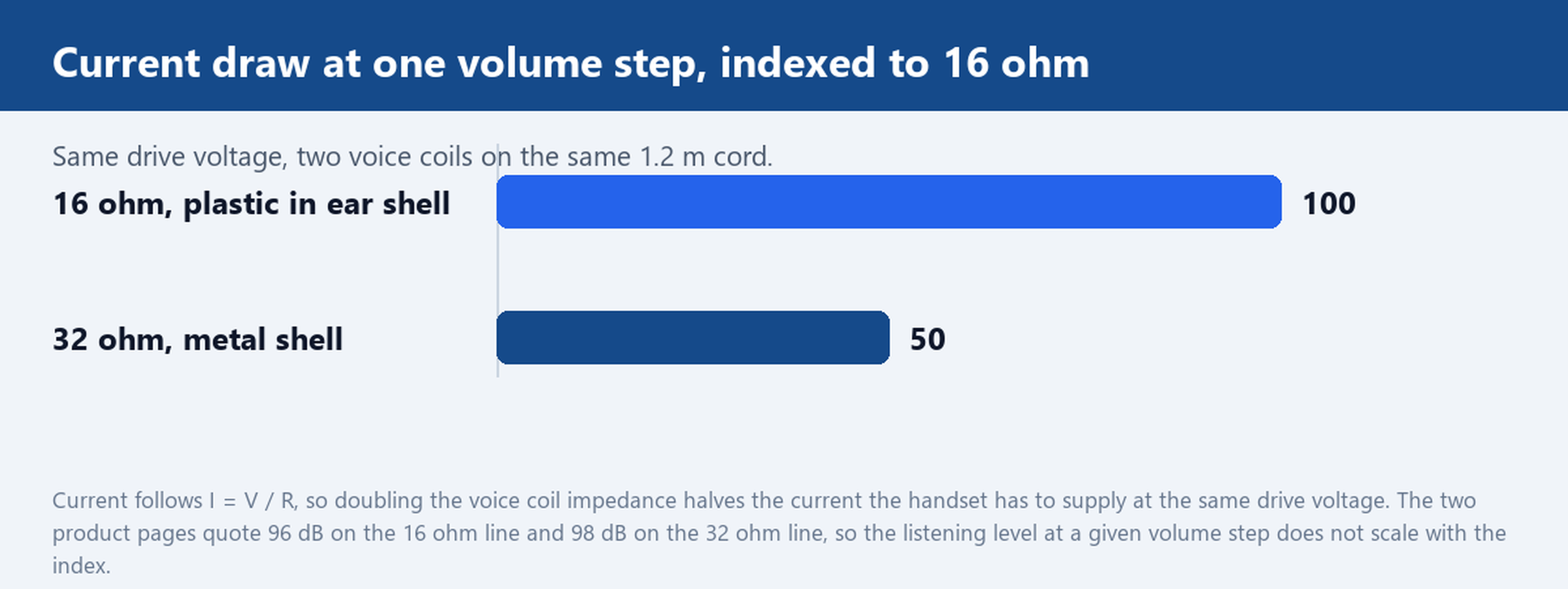
A commuter earphone has to survive two rides a day, and the specification that decides whether it does is shell shape, cord length and plug wiring, not frequency response. Our wired range is catalogued as in-ear, with a 10 mm driver, 16 ohm impedance at plus or minus 10 percent, 96 dB sensitivity, a 1.2 m cord and a gold plated stereo 3.5 mm plug. The metal shell line is quoted at 32 ohm and 98 dB on the same 1.2 m cord. That is the whole decision surface for most buyers, and the sections below walk through it in the order a rider notices problems.
In-Ear or Half-In-Ear: What Changes Over Two Rides a Day
An in-ear shell pushes a silicone tip into the ear canal. It holds by the friction of that tip, and it blocks a useful share of carriage noise as a side effect of the seal. A half-in-ear, or earbud, shell rests in the concha bowl at the entrance to the canal and holds through shell geometry and a light clamp instead of a seal.
The difference shows up in two places. Retention comes first: an in-ear pair works loose when the tip is the wrong size for the wearer, which is why a tip assortment is a real line item and why fit has to be tested per wearer rather than per model. A half-in-ear shell cannot be tuned that way. Its holding force is set at tooling, so a shell that fits badly stays bad for the life of the order. Noise comes second. Without a seal the rider turns the volume up, and the handset pays for that in battery.
For buyers the practical consequence is that the two formats need different diligence. With an in-ear line, get the tip assortment right and test with people who will actually wear the product. With a half-in-ear line, sign off the sample fit before tooling, because shell geometry is not something that can be corrected in a packing list later. The earphone category on this site is catalogued as in-ear; if your assortment plan calls for a fixed earbud shell, raise it before the colour run rather than after it. The 16 ohm in-ear model is the reference point for the figures quoted above.
1.2 m of Cable: Where the Extra Length Ends Up at a Turnstile
Both wired lines ship on a 1.2 m cord, measured from the plug to the earpiece. On a standing rider with the handset in a front trouser pocket, that length arrives at the ears with slack to spare, and the slack has to live somewhere. In practice it collects around a jacket edge, a bag strap or a coat button, which is why the cord, not the driver, is what fails first on a commuter pair.
The load lands at the plug. When a strap catches the cord and the rider keeps walking, the plug is levered sideways inside the socket, and the point that gives way is the junction between the moulded body and the cable. A strain relief with real length behind the plug distributes that load; a short collar does not. Our wired models carry a gold plated stereo 3.5 mm plug with moulded relief at the body, and the plastic in-ear line adds a second hard point in the form of an on-cord volume wheel, which is convenient but is also a place where a pulled cord can fail.
Two things are worth writing into the order. State the measuring convention, because a cord measured to the splitter and a cord measured to the earpiece are different products at the same nominal length. Then decide whether the extra length should be managed or removed. If your market pockets the handset and walks, a tangle free wire construction such as the 32 ohm metal shell with tangle free wire removes a good part of the problem before it starts, and the metal earphone line is the one to quote when a heavier shell is part of the brief.
The 3.5 mm Plug and the Adapter Buyers Forget to Order
A stereo 3.5 mm plug has three contacts: tip, ring and sleeve. Add a microphone and the plug becomes four pole, with the mic and the ground sharing contacts that used to carry audio alone. That fourth contact is where orders go wrong, because a passive adapter that was designed for audio only will pass sound and leave the microphone invisible to the handset. The rider hears music, the caller hears nothing, and the return lands on your desk rather than on the supplier who shipped the wrong adapter.
The fix is procedural, not technical. Quote the earphone and the adapter against one specification sheet, with the contact assignment written down, so the two parts are known to match before either is packed. Where an assortment is sold as a bundle, insist that the adapter sample arrives with the earphone sample, not after it.
Handsets without a headphone socket are the second half of this problem. For those, the choice is a plug adapter or a Bluetooth transmitter, and the transmitter route removes the cord question entirely. Our Bluetooth transmitter range covers the car and desk cases, and the wired in-ear headset with in-line mic shows the other end of the same decision, with a mic switch and a cord volume control so the wearer does not have to reach for the handset on a crowded platform.
Colour Assortments at a 1,000 pc Minimum
The 16 ohm plastic in-ear page lists fifteen colour names, from beige and black through to silver, white and yellow. At a minimum order quantity of 1,000 pcs, fifteen colours average out at roughly 66 pcs each, which is a thin run per colour for any moulding or assembly line. Narrow the assortment to three to five colours and put the rest on a reorder list.
Two details cause most of the arguments after delivery. The first is that colour is set per part, not per product: the shell and the cord are separate decisions, and a supplier who quotes one colour for the pair will deliver something the buyer did not picture. The second is that a multi colour entry in a product listing is not a colour at all but an assortment, so it needs a ratio rather than a name. Write the ratio down before the order is confirmed.
Packing deserves the same care. The plastic in-ear pages list 300 pcs per carton in a 53 x 44 x 37 cm carton at 10.5 kg gross and 9.5 kg net, while two of the plastic models list 24.5 kg gross and 22.5 kg net for the same carton count and footprint. Both figures are on this site, so confirm which packing line applies to your order before freight is quoted, and confirm whether a carton may carry a single colour or a mixed set.
What to Test on a Sample Pair Before the Colour Run
A fit test is the first item and it cannot be done on a desk. Wear the sample for ten minutes while talking, walking and turning the head, because jaw movement is what dislodges an in-ear tip that felt fine while sitting still. If the tip is wrong, the symptom is a slow loss of seal rather than a fall, and the wearer will report it as thin sound rather than as a fit problem.
Next, load the plug the way a pocket does. Hang the sample from the plug body with the cord over an edge, then pull gently and watch where the moulding flexes; a stiff collar passing the load straight into the cable is the failure you are looking for. After that, record a voice memo over the mic in a corridor rather than a quiet room, since an in-line mic placed low on the cord picks up clothing rustle that a quiet test will never reveal.
Finish with three checks that cost almost nothing. Play a mono track and confirm both channels are at the same level. Coil the cord the way a rider pockets it, then see whether it comes out straight. And hold the shell against the approved colour chip in daylight, not under office lighting, because a warm white lamp will pass a shell that a customer rejects outdoors.
The Spec Sheet to Send With the Enquiry
A short, complete brief removes most of the back and forth. List the shell format, the driver size, the impedance and sensitivity you need, the plug type with its contact assignment, the cord length and the point it is measured to, whether a mic and a switch are required, the colour split per shell and per cord, the packing count, and where the logo goes. If any line is open, say so, because a supplier filling a gap with an assumption is how a shipment arrives almost right.
Send your colour split and target quantity, and we will ship sample pairs of the 16 ohm in ear and the 32 ohm metal shell so you can fit test both formats before the colour run. If you are still shortlisting, start from the wired earphone category and work back to the spec sheet from the models that match your price band.
