

A mixed car mount order is where per-piece pricing stops meaning anything. Two suppliers quote the same style, one at a lower unit price, and the difference turns out to be a different clamp, a poly bag instead of a colour box, or a quantity quoted as one total across six models rather than per model. The unit price of a car phone mount is assembled from four parts: the hardware, the packing, the quantity actually ordered of each SKU, and the freight basis. Change any one of them and the number moves while the product stays identical.
Why a Mount Quote Cannot Be Compared per Piece Alone
A car phone mount looks like a simple object and behaves like an assembly. An air-vent clamp, a ball joint, an arm, a cradle or a magnet plate, and a set of pads. Each part carries its own tooling, its own minimum run at the moulding machine and its own defect rate. When a quote arrives as a single figure, that figure is an average across a structure nobody has seen.
The practical consequence is that the lowest quote is often the one with the smallest scope. Drop the retail box, ship in a poly bag, and the unit price falls by more than the box costs, because packing is labour as well as material. Halve the quantity of the slowest model and the average improves while the order becomes harder to fulfil. Neither change is dishonest. Both make the number incomparable.
So the first move is not to negotiate. It is to ask for the structure: one line per model, one line per packing format, and the quantity that each price assumes. A supplier who can produce that sheet is quoting. A supplier who cannot is estimating, and the estimate will be revised once the order is real.
Per-SKU MOQ and How Sharing One Clamp Lowers the Price
Minimum order quantities in this category are set per model, not per order, because the constraint is the moulding and assembly setup for that model. A buyer who orders a thousand pieces across five models has not met the minimum for any of them. A buyer who orders two hundred of each has met five minimums and usually ends up with a better total price than the first buyer, which surprises anyone who treats volume as a single number.
The lever that genuinely moves cost is hardware sharing. Air-vent clamps and ball joints are common across many heads. If two of the five models in a mixed order can use the same clamp and the same ball joint, the tooling and the setup are paid once, the defect rate is watched on one part instead of two, and the line does not stop to change fixtures. The saving is real, and it appears as a lower per-unit price without any concession from the factory.
Ask for the part numbers of the shared components and confirm they appear in more than one SKU. A supplier who designs the range this way will have those numbers to hand. A supplier who does not will offer a discount instead, which is a different thing and usually expires with the order.
Blister, Color Box or Poly Bag: The Packing Line That Moves Unit Cost
Packing is the second half of the unit price and the half buyers examine least. Three formats dominate. A poly bag with a header card is the cheapest and suits marketplace sellers who ship in their own mailer. A printed colour box costs more in material and in the labour to fold, insert and seal, and it protects the product through a retail chain. A blister on a printed card is the most expensive of the three, because the forming tool is dedicated to the product outline and the card print run is separate.
Each format also changes the carton. A colour box has fixed outer dimensions, so cartons can be designed around it and pallet counts become predictable. Bags deform, which usually means the carton ends up larger than the contents require and the billable volume rises. That is a freight cost wearing a packing label.
When two prices are on the table, ask which format each assumes and whether an insert, a manual or a cable bag is included. Those three items are small, cheap and very often the reason two quotes differ by a margin that looks like a negotiation gap but is really a specification gap.
Mixed Cartons, Volume Weight and Who Absorbs the Freight
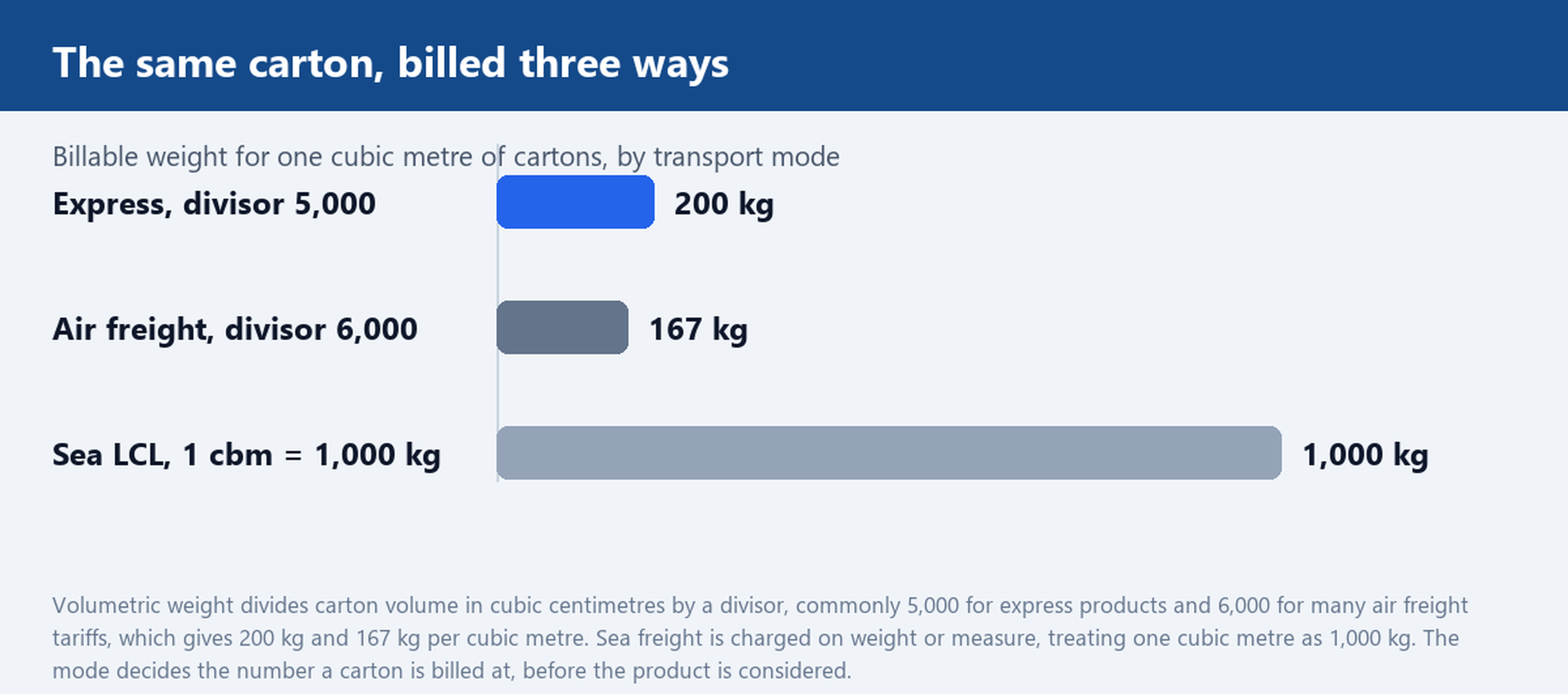
A mixed order produces mixed cartons, and mixed cartons are where freight stops being intuitive. Mounts are light for their volume, so most shipments are billed on volumetric weight rather than actual weight. Express products commonly divide cubic centimetres by five thousand, many air freight tariffs divide by six thousand, and sea freight charges on weight or measure with one cubic metre treated as a thousand kilograms.
The consequence is that a packing decision made to save a few cents per unit can raise the freight bill by more than it saved. A carton two centimetres deeper than necessary, repeated across a hundred cartons, changes the billable volume of an entire shipment. Carton dimensions belong in the quote, not in a shipping email three weeks later.
Then there is the question of who pays which leg. A quote that stops at the factory gate and a quote that includes delivery are not comparable, whatever the unit prices say. Fix the Incoterm first, then compare. If freight sits with the buyer, ask for the billed weight the supplier expects, so the shipping cost can be estimated before the order is placed rather than after the invoice arrives.
A Quote Sheet Two Suppliers Can Be Compared On Line by Line
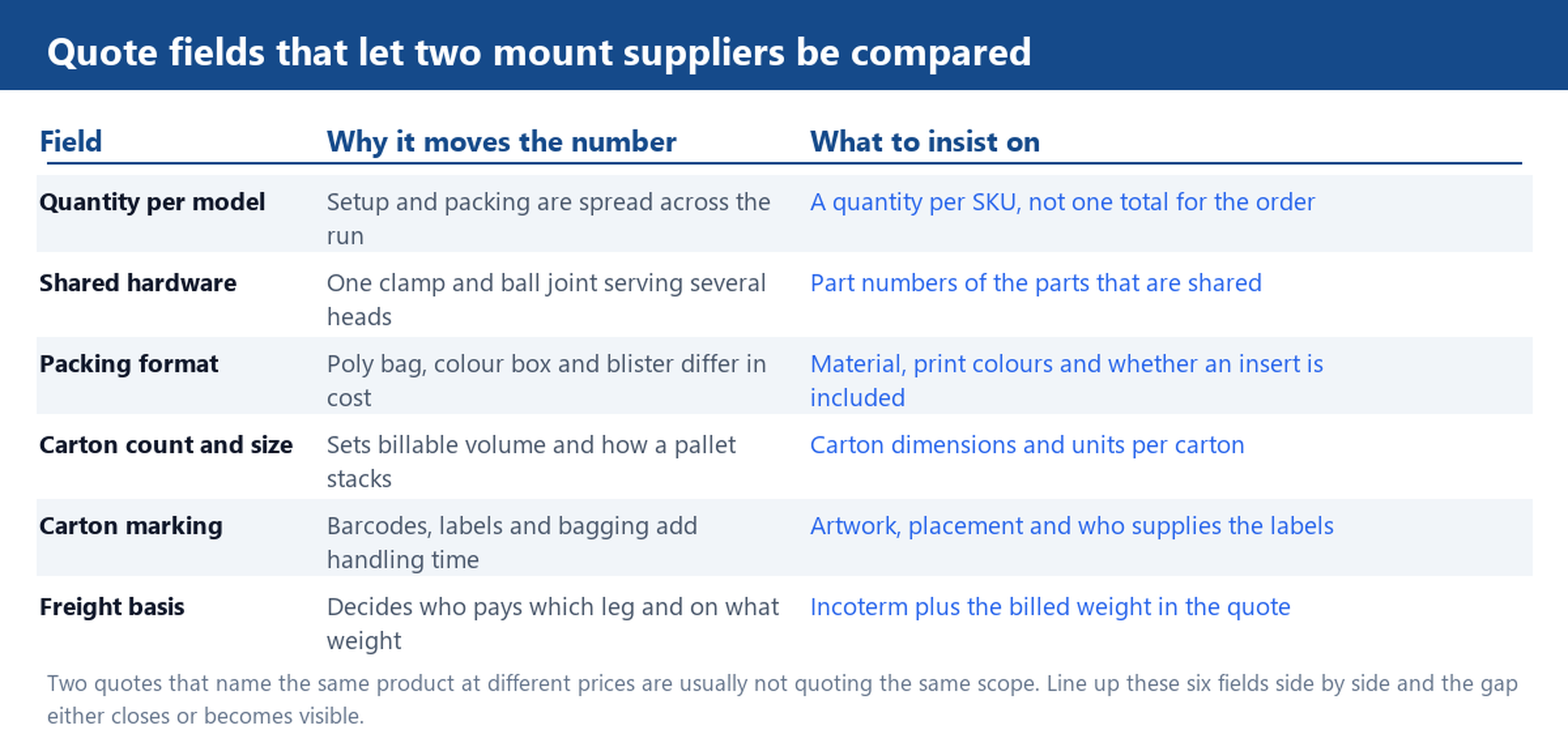
The sheet below makes the comparison mechanical. Six fields, filled by each supplier, and the differences either explain the price gap or reveal that the scopes never matched in the first place.
Two behaviours are worth watching when it comes back. A supplier who fills every field with a range rather than a figure is saying the numbers are not yet fixed, which is fair at quotation stage but should be tightened before the order. A supplier who leaves the shared-hardware line blank usually has not designed the range around common parts, which means the second model will cost as much to set up as the first, and the mixed order loses the advantage it was supposed to bring.
For reference, an auto-clamping air-vent mount and a 15W magnetic car mount sit in different cost structures: the first is clamp and spring hardware, the second adds a magnet array and a charging coil, so their quotes respond to different levers. Comparing them on a single blended unit price tells a buyer nothing. Our car accessories range lists both families, and the mobile phone accessories section covers the in-car charging pieces that usually travel in the same carton. The services page explains how a mixed order is scheduled, and the contact page is where a model list can be sent for a line-by-line quotation.
Send your mount list with target quantities per model, and we will quote the air-vent clamp and 15W magnetic car mount lines with packing and carton options split out separately.
