

A commuter does two things with a phone mount, forty times a day: put the phone down with one hand, and take it up with one hand. Everything else about the product is secondary. That is why a mount that costs the same as another can fail in one vehicle and work for years in the next: the difference is vent geometry and case thickness, not the brand on the box. Car accessory for daily commute purchases go wrong when the buyer surveys the catalogue instead of the dashboard.
Two Mount Families and the Motion Each One Removes
The vent-clamp family removes the search motion. A pronged clip hooks between the slats of an air vent, a ball joint tilts the head toward the driver, and spring-loaded or sensor-driven arms close on the phone when it is pressed into the cradle. The auto-clamping vent mount does exactly this: the arms swing outward as the phone is set on the pad and then close against the case edges, so the hand never has to open a clamp.
The magnetic family removes the alignment motion instead. A disc holds a ring of magnets under a flat face, and the phone is set down onto the plate rather than into a cradle. The magnetic disc mount uses an aluminium ring over an ABS base, flat on the dashboard, with the cable routed behind the housing. There is no clamp to open and nothing to aim at, which is why drivers who mount and unmount at every stop tend to prefer it.
The trade is what each one grips. A clamp holds the phone by its edges and does not care what the case is made of. A magnet holds by attraction and cares about everything: the case material, its thickness, and whether there is a steel ring inside it. Choose the family from the motion the driver repeats, then check whether the vehicle and the phone allow it.
Vent Geometry: Blade Thickness, Slat Spacing and Clamp Travel
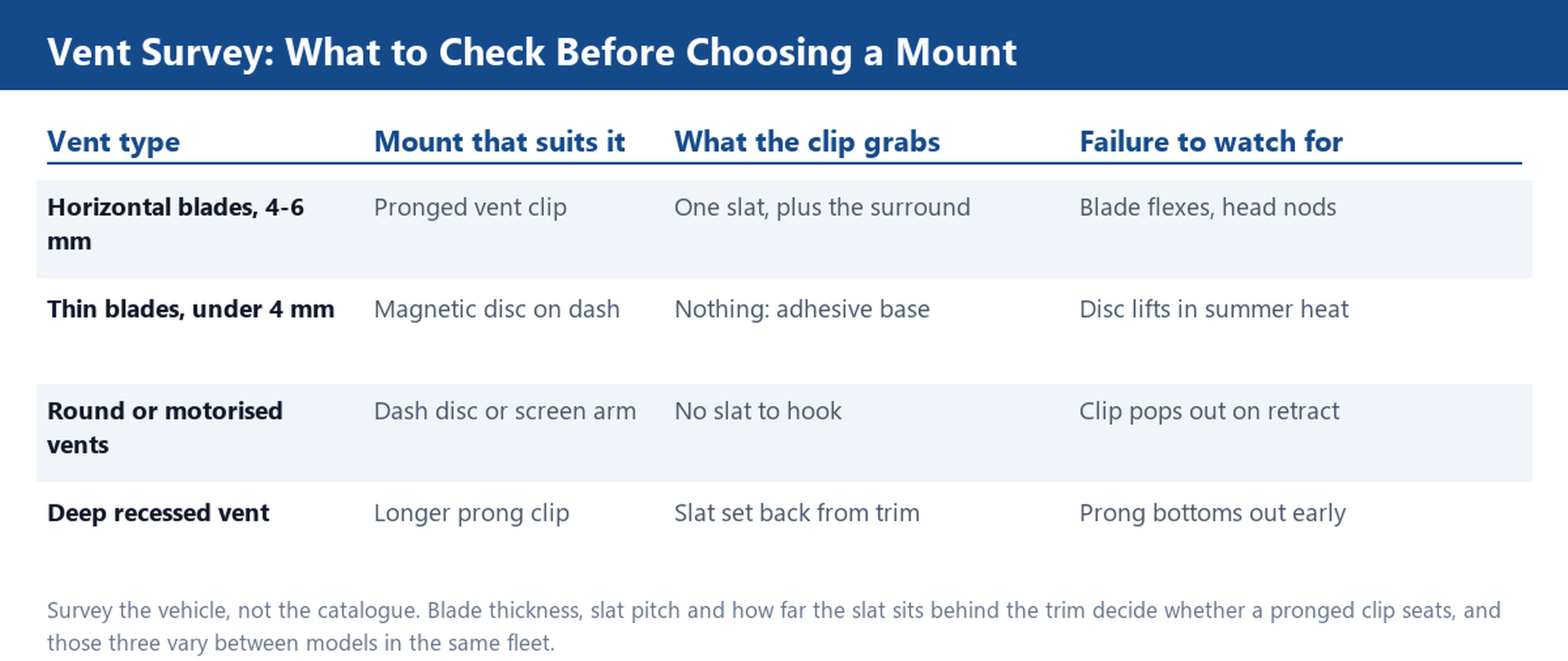
A pronged clip does not grip the vent frame; it hooks one slat and leans on the surround. That makes the slat the load path. Horizontal blades of four to six millimetres give the prong something to sit behind and enough stiffness to resist the lever arm of a phone on a ball joint. Blades under four millimetres flex, and a flexing blade turns every road joint into a slow nod of the screen.
Slat pitch matters as much as thickness. The prong body has to pass between two slats, so a tight pitch will not accept a wide clip no matter how the jaws are adjusted. Round vents, motorised vents that rotate closed, and vents recessed well behind a trim panel each break the assumption in a different way: the first has no horizontal slat, the second can retract and push the clip out, the third needs a longer prong than the standard body provides.
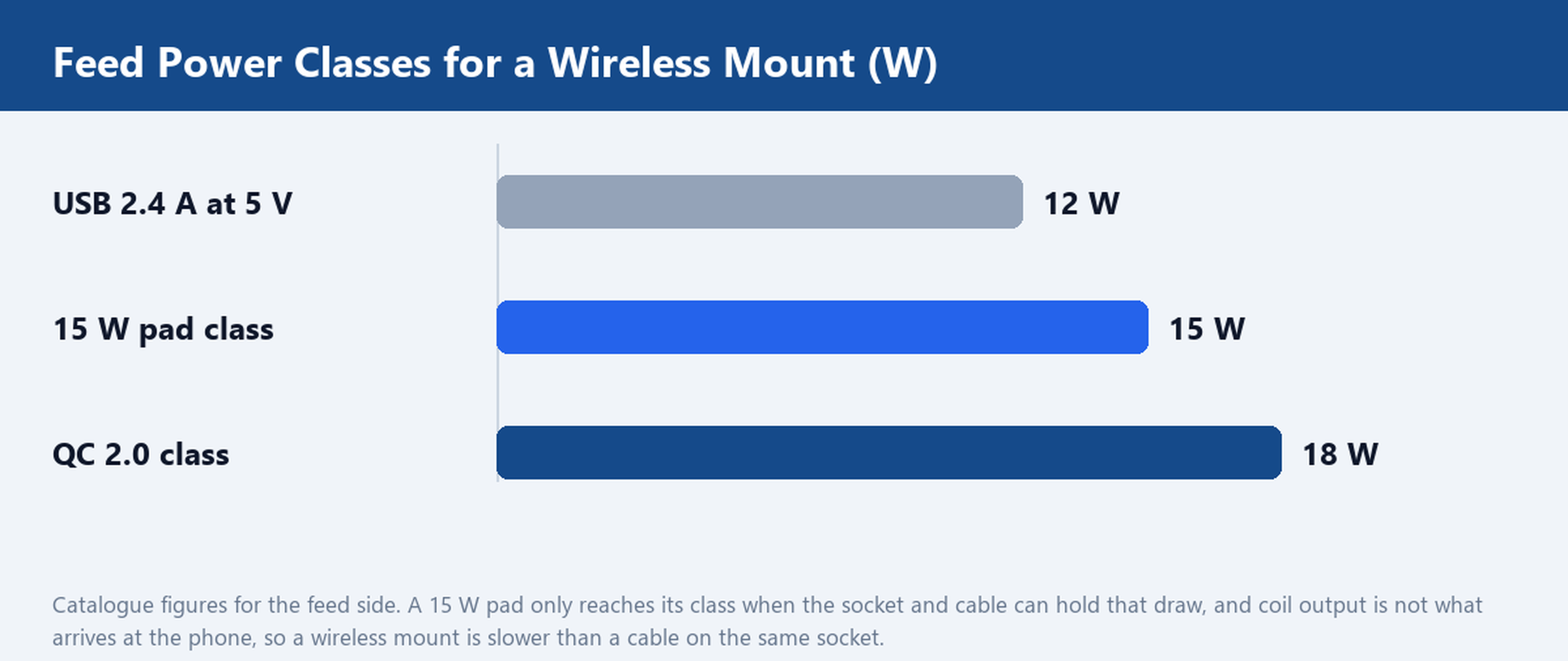
Clamp travel is the third number, and it belongs on the purchase order along with the opening range. Travel has to cover the phone plus its case at the widest point. A rugged case can add enough width that the arms close on the case with the coil no longer centred over the phone, and a wireless pad that is off-centre loses coupling before it loses grip. Ask for the opening range in millimetres, not for a phrase like fits most phones. The feed side needs the same discipline, because a wireless head can only draw what the socket and cable supply.
Magnetic Mounts and the Case Underneath: Magnetic Shell vs Adhesive Plate
A magnet mount is a system of three parts: the magnet ring, whatever ferrous material is in the phone or case, and the gap between them. Holding force drops steeply as that gap grows, so a case that is two millimetres thick behaves very differently from one that is five. If the phone has a magnetic ring built in, the mount works as shipped. If it does not, an adhesive plate has to go on the case or on the phone back, and that plate becomes part of the product the customer experiences.
Two consequences follow for a buyer. First, a metal plate in the wrong place blocks wireless charging, so the plate has to sit clear of the coil, which usually means a ring shape rather than a solid square. Second, the plate adds thickness and its adhesive sees summer dashboard temperatures, so the failure mode is not a dropped phone in winter but a plate that lets go in July. Specify a plate with a ring cut-out and a stated adhesive, and test one on a dashboard in direct sun before approving the batch.
Heat also explains a difference between the two families that has nothing to do with grip. A vent mount sits in moving cooled air while the phone charges; a dashboard disc sits in the sun. A phone that throttles its charge on a hot dash will do it on any mount, but the vent position makes the problem smaller, and that is worth mentioning to fleet drivers who run navigation for a full shift.
Phone Weight, Vibration and the Nodding Problem
Any mount is a lever. The phone hangs at some distance from the ball joint, and the joint has to hold that torque against bumps. A large phone with a case weighs roughly two hundred grams, and at a few centimetres of offset that is a meaningful load on a small friction joint, especially on a vehicle with firm suspension. The symptom is a screen that tilts down over a drive and has to be pushed back at every stop.
The fix is structural, not a matter of tightening. Arms that meet the phone across a broad flat face spread the load better than arms that only touch the rim, and a short head with the joint close to the vent reduces the lever arm. On the magnetic side, a larger plate diameter spreads the same holding force over more area, which resists rotation as well as pull-off. When a sample fails the nod test, the answer is a different geometry, not a stronger spring that will eventually mark the case.
Test it the way the driver will use it: mount the phone, drive a route with speed bumps and a rough patch, and watch the screen rather than the mount. A head that holds its angle on that route will hold it in service. A head that sags even slightly will sag more once the joint wears.
Building a Small Mixed Order for a Mixed Fleet
Fleets rarely have one vent type. The practical order is two SKUs and a survey: one pronged vent clamp for the vehicles with serviceable horizontal blades, one magnetic disc for the vehicles with round, motorised or thin-blade vents, plus a written record of which vehicle gets which. Two SKUs cover a mixed fleet better than one universal mount, and they cost less to support than a single product that half the drivers return.
Keep the accessory list short and deliberate. A short cable that reaches from the vent to the socket without crossing the steering column, a socket feed that can hold the pad class, and a spare adhesive plate per ten units are usually enough. The car charger range is where the feed side gets matched to the mount, and the car kit range is where a mount, a cable and a charger get bundled for a driver handover.
Then fit-test before committing. Three vehicles, one of each vent type in the fleet, one phone model per driver group, ten minutes each. A mount that survives that test in the actual cars removes the entire category of complaint that no specification sheet predicts. The car accessories range covers both families, and the fit check is the part worth doing first.
Send us the vent type and the phone models your drivers use, and we will send one vent clamp and one magnetic mount to fit-test in the actual cars, so the order is decided by the dashboard rather than by a photo.
