

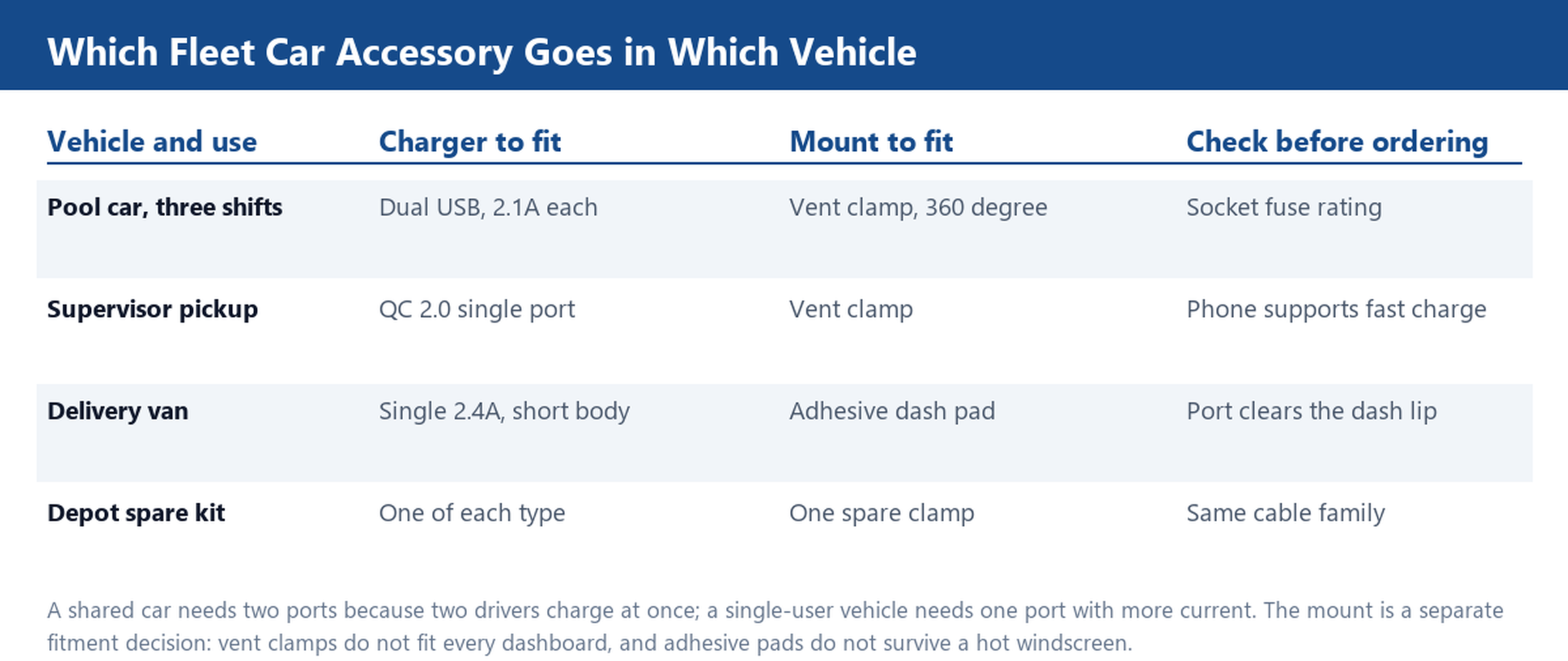
Fleet car accessories fail in a pattern that is easy to spot once you have seen it twice: the charger is missing, the mount has been swapped between vehicles, and nobody knows which phone was on which cable. A pool car shared across three shifts has two people charging at once, a supervisor pickup has one person who wants a fast charge between sites, and a delivery van has a dashboard that will not take a vent clamp at all. Buying one charger and one mount for the whole fleet looks efficient on the purchase order and produces a depot full of parts that fit nothing. This guide splits the fleet into four vehicle situations, matches a charger and a mount to each, and then lists the spares that keep the vehicles on the road between orders.
One Socket, Many Drivers: Splitting 12V Output Across Shifts
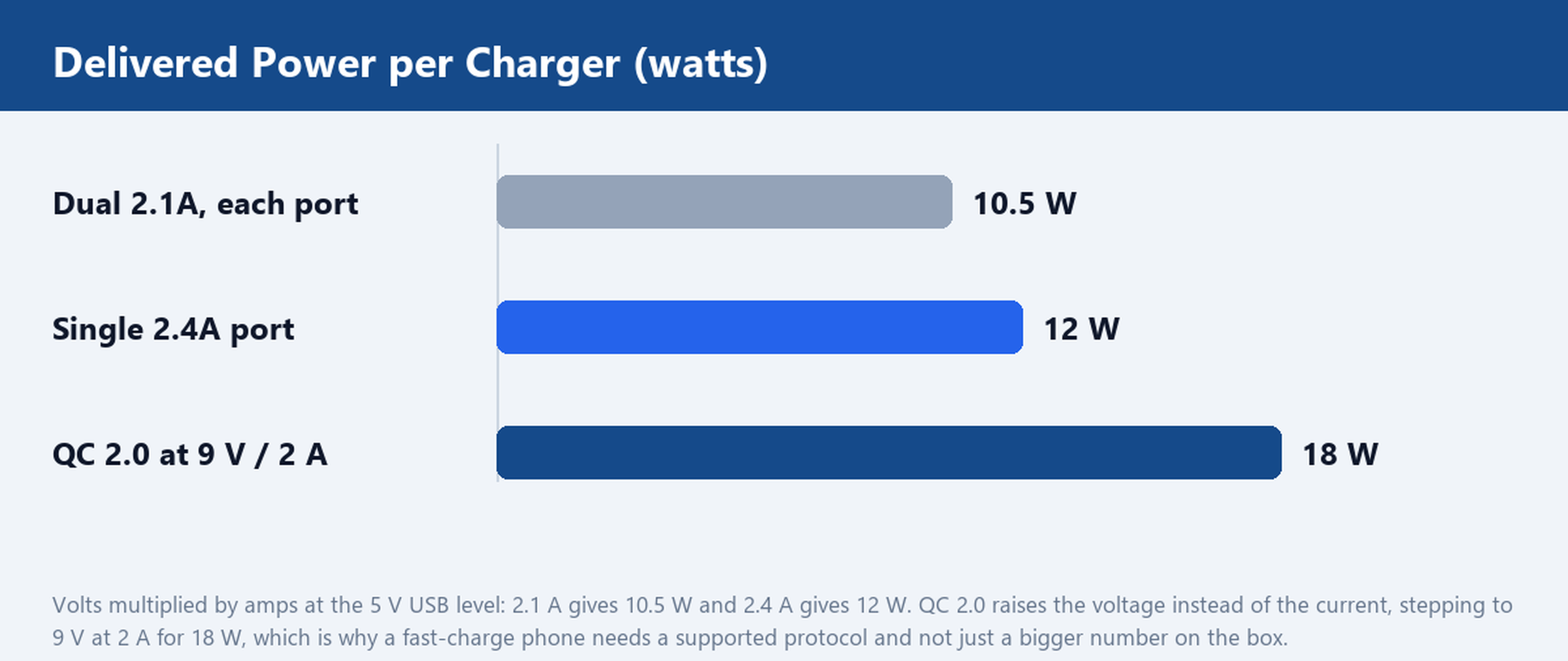
Every vehicle has one 12 V accessory socket, and it is fused for a current the manufacturer chose for the original equipment, usually somewhere around ten to fifteen amps. That fuse is the ceiling for everything plugged into the socket, and it is also the reason a dual charger is not simply twice the power of a single one: the two ports share one input. A dual unit with 2.1 A on each port delivers 4.2 A at 5 V, which is about 21 W, and at 12 V input with typical conversion losses that is a little over 2 A drawn from the socket. Two phones charging at once is comfortably inside the fuse; the same unit running a phone and a tablet at full rate is where drivers start finding the limit.
A pool car is the case where this matters. Three drivers on three shifts means the charger is plugged and unplugged dozens of times a week, two devices are often charging together at the handover, and the unit is the first thing to be borrowed and never returned. The specification that survives this is unglamorous: a dual port unit with a short body that seats fully in the socket, a firm spring contact so it does not rotate loose over hundreds of insertions, and a light that is visible in daylight without being bright enough to distract at night. Our dual port OKC563 is built to that pattern, and the three-port OKC561 covers the driver who also charges a work phone and a tablet.
The purchasing rule for shared vehicles is to fix the port count by the number of devices at handover, not by the number of drivers. Two drivers swapping a car do not need four ports; one driver carrying a phone and a tablet needs two on their own.
2.1A Dual, 2.4A Single and QC 2.0: Which Charger Belongs in Which Vehicle
The three charger types in a typical fleet catalogue differ in a way that is easy to state and easy to get wrong. A dual 2.1 A unit splits its output across two ports and is the right answer where two devices charge at once. A single 2.4 A unit puts all of its current into one port, which is the right answer for a one-driver vehicle because the phone charges faster on the same hardware budget. A QC 2.0 unit changes the negotiation instead of the current: it steps the voltage up to 9 V and the phone draws 2 A, which is 18 W rather than the 10.5 W that 2.1 A at 5 V delivers.
That difference only shows up when both ends support the protocol. A QC 2.0 charger with a phone that negotiates only the standard 5 V level will behave like an ordinary 2 A charger, and a phone that supports quick charging will fall back to the same level on a plain 2.1 A unit. Before a fleet standardises on quick charging, check the phones the drivers actually carry, because a charger that cannot negotiate with the handset is a charger that will be reported as faulty. The unit OKC566 carries the QC 2.0 output for the vehicles where the handset list supports it.
The mount decision then follows the dashboard rather than the phone. Wireless charging pads such as OKC4905 at 15 W and the magnetic OKC4897 simplify the cab because there is no cable to plug, but they add two requirements: the phone must hold without a case that blocks the coil, and the mount must be rigid enough that the phone does not shift off the coil on a rough road. A 15 W wireless pad that drops to a trickle because the phone slid two millimetres is worse than a cable in practice, so the clamp force is the specification that matters, not the wattage on the box.
Mounts That Move Between Vehicles: Vent Clamp, 360° Rotation and Magnetic
Mounts are the part of a fleet order that gets the least thought and generates the most complaints, because a mount is a fitment problem disguised as an accessory. A vent clamp grips a louvre, which means it depends on the vent having a rigid horizontal blade and on the dashboard behind it having room for the phone. Vehicles with round or vertical vents, or with a screen integrated into the centre console, will not take one. An adhesive dash pad gives more freedom of position but lives on a surface that reaches high temperatures in summer sun, and a pad that lets go at temperature takes the phone with it.
Rotation is a specification with a number attached. A 360 degree ball joint lets the phone sit in portrait for navigation and landscape for a form or a camera feed, which is why units such as OKC4890 are specified that way. The joint is also the wear point: a ball that is tight enough to hold a phone at an angle on day one becomes loose after a few hundred adjustments, and the phone then droops on every bump. Ask for the ball diameter and the material of the socket, and test the hold by mounting the heaviest handset in the fleet rather than a light demo phone.
Magnetic mounts solve the wear problem by removing the joint, and they add a supply problem instead: the metal plate has to live on the phone or inside its case, and a fleet with ninety phones has ninety plates to distribute and replace. They work well where the phones are company-issued and the plates can be fitted once at handover. They work badly in a mixed fleet where drivers bring their own handsets, which is exactly where a vent clamp with a universal cradle stays in service longer.
Spare Parts and Swap Cycles: What to Keep in the Depot
A fleet does not buy accessories, it buys uptime, and the depot stock is what converts one broken part into a five-minute swap instead of a week of downtime. The list that earns its shelf space is short: one spare charger of the type fitted to the most vehicles, one spare mount of each type in use, and a small number of cables in the connector the fleet actually uses. Buying a spare of every SKU is a way of freezing capital in a drawer; buying none is a way of paying for express freight.
The swap cycle is the second half of the same decision. A charger that fails is usually a spring contact that has lost tension or a USB socket that has been worked loose, and both failures are visible on inspection. Adding a check to the existing vehicle inspection, mount tight, cable intact, ports clean, turns a failure that strands a driver into a replacement at the next depot visit. The cost of that check is a minute; the cost of the alternative is a driver on a route with a dead phone.
Keep the swap honest by matching part numbers. A depot that stocks three visually similar chargers will mix them, and the mixed unit will end up in the vehicle whose phone does not support its protocol. One part number per vehicle class, written on the bin and on the vehicle record, is worth more than a discount on a mixed carton. The car chargers and car accessories ranges are grouped so a class of vehicle maps to one SKU rather than a family of lookalikes, and the small tools that go with the swap live under car tools.
Writing the Fleet Purchase List: Fitment, Packing and Reorder Point
A fleet purchase list is a fitment document before it is a shopping list. For each vehicle class it should state the charger type, the port count, the mount type, the connector the phones use and the fuse rating of the socket the unit will live in. Adding the model year of the dashboard is not excessive: vent louvre spacing changed on several common van platforms within a single generation, and a clamp that fitted last year may not clip this year.
Packing follows from the same logic. Units supplied loose in a carton are cheaper and arrive with scratched bodies and missing clips; units bagged per vehicle set, charger plus mount plus cable, cost slightly more and remove a step at the depot. For a fleet of any size the bagged set wins, because the person fitting it is not the person who placed the order and should not have to match parts from a description.
Set the reorder point from the swap rate rather than from the calendar. If the depot replaces a charger when the spring contact fails, the reorder point is the number of spares that covers the interval between orders, and the order quantity is that number plus the growth in vehicles. Reviewing the point once a year against the actual failures is enough. Write the number on the bin, and the fleet stops ordering a year of stock after a single bad month.
Send your vehicle list and the phones your drivers carry, and we will quote a mixed fleet pack with one charger and one mount sample per vehicle type.
