

The sample is not a preview of the bulk order. It is the one point in the process where you can test the three things a catalogue photo cannot show: whether the clip seats on the vent in the car you had in mind, whether the phone completes the fast handshake or quietly falls back to a slow one, and whether the joint still holds the phone steady after a hundred kilometres of rough road. A car accessory sample order is a test of those three, and unit price is the last thing it should be judged on, because a mount that drops off the vent is expensive at any price per piece.
What a sample is actually for: fit, handshake and finish, not the unit price
A bulk run of two thousand pieces is decided by a document, and the sample is how that document gets written. Every check below produces a sentence that can go into a specification: the clip opens to this much, the pad delivers this rate to this phone, the joint holds this weight at this angle. Without those sentences the bulk order is being placed against a photograph.
One condition makes the sample meaningful. It has to come off the same tooling and the same bill of materials as the production run, and the supplier has to say so in writing. A hand-built sample that uses a stronger spring than production is worse than no sample, because it passes a test the bulk will fail.
Ask for the specification sheet to travel with the unit. On the charger side the sheet is short and specific: output steps, input range, material, weight, warranty. The car charger in this line lists 5 V, 9 V and 12 V output, a 12 to 24 V input, 60 g, an ABS body and a 13 month warranty, which is enough to write a purchase clause from. What the sheet will not tell you is how any of it behaves in your hand, which is the reason the unit ships at all.
Mount checks: vent blade thickness, clamp travel and the 360 degree joint
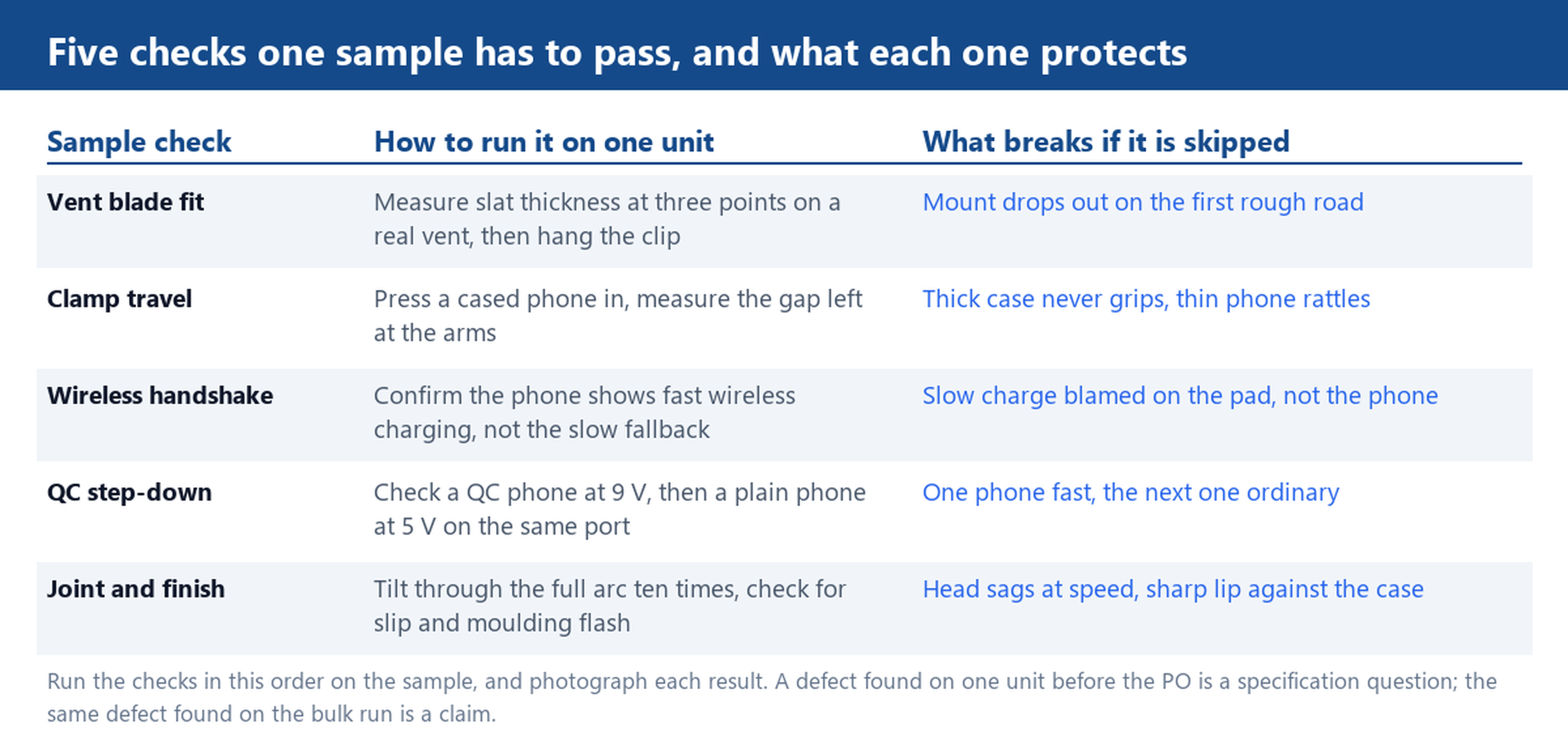
Start with the vent, because it is the part of the equation the supplier never sees. Slats taper along their length and differ between models, so measure thickness at three points on one slat and write down the smallest and largest figure. Then hang the clip on a spare vent of the same type, not on a bench edge, and press down as if closing a door on it.
The judgement is simple. If the clip opens to less than the thickest slat plus a millimetre of clearance, it will seat on the thin end and fight the thick end, and in a car that means a mount that looks fitted and lets go on the first speed bump.
Clamp travel is the second measurement, and it needs the phone you actually sell to. The arms on this mount are spring-loaded and swing outward as the device is pressed in, then close against the case edges. Put the thickest cased phone in your range on the pad, let the arms close, and measure the gap left between arm and case. No gap at all means the arms bottomed out before gripping, which will feel solid on the bench and rattle on the road; a large gap means a thin phone in the same cradle will not be held.
Then work the joint. Tilt the head through its full arc ten times and check whether it returns to the same angle or sags a degree or two each pass. A ball joint that holds on the first movement and slips after ten is the classic sample-pass, bulk-fail pattern, and ten cycles cost nothing to run. Finish belongs in the same pass: run a finger along the inner lips that face the phone, because moulding flash there scratches a case every time the device goes in.
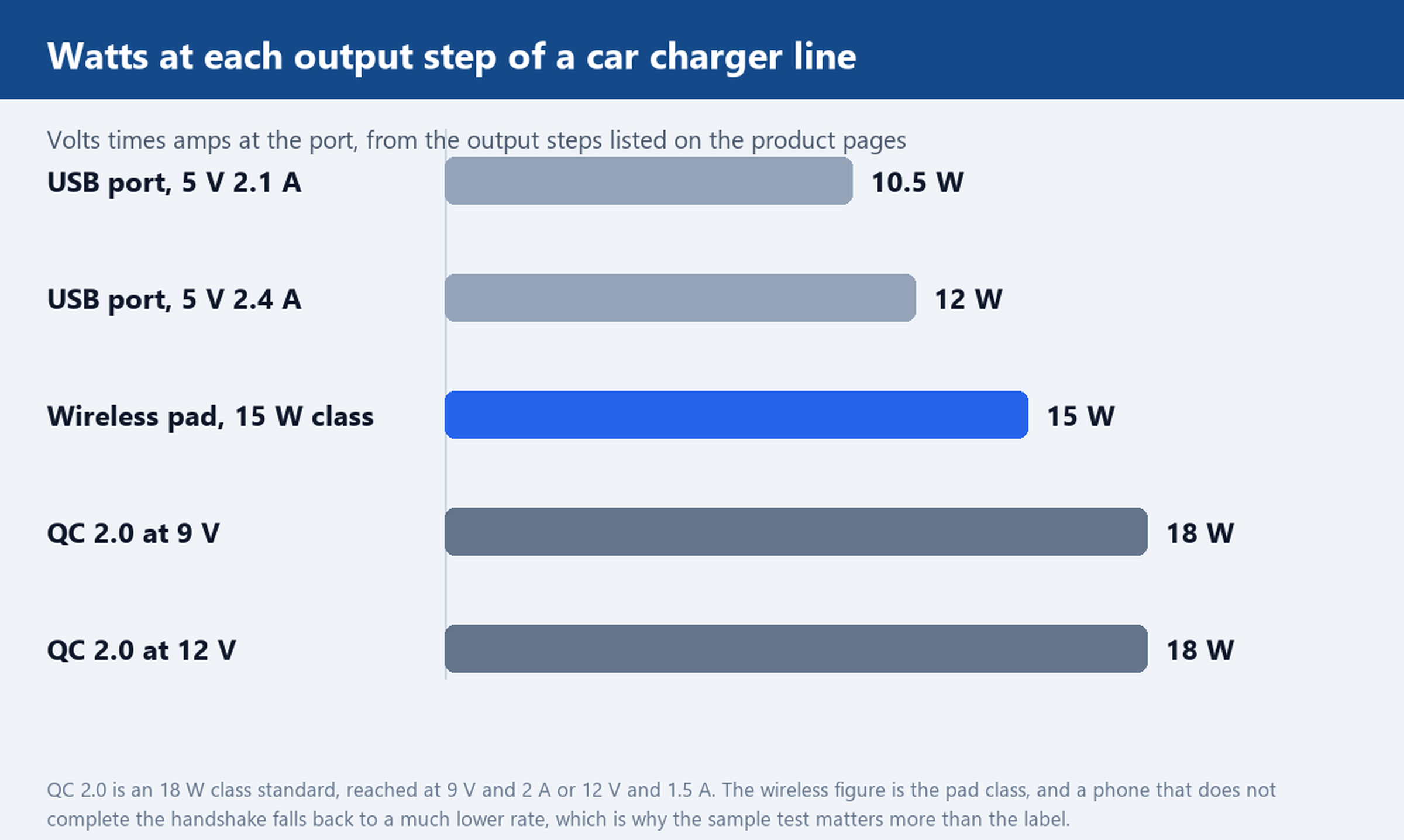
The charger side has its own set of numbers, and the chart below is the frame for them.
Charger checks: 15 W wireless handshake, QC 2.0 step-down and the 2.4 A port under load
Wireless charging is the check most samples fail quietly. A 15 W pad and a phone that does not complete the handshake still charge, so the unit looks fine and the customer complains about speed three weeks later. The test is to watch the phone, not the pad: a compatible device reports fast wireless charging on screen, and an incompatible one reports ordinary charging at a much lower rate. Repeat with the two or three phone models that make up most of your volume, because coil position on the phone decides the result as much as the pad does.
QC step-down is the second check, and it needs two phones. A QC-capable phone should negotiate 9 V and report fast charging; a plain phone on the same port should stay at 5 V and charge at an ordinary rate. If the plain phone is pushed to a higher voltage it did not ask for, the negotiation is being forced rather than agreed, and that is a warranty claim waiting to happen. The input range matters here as well: a 12 to 24 V input means the same unit runs in a passenger car and in a truck cab, so test it in both if both are in your market.
The third check is the plain port under load. A 2.4 A port at 5 V is 12 W, and the way to test it is a phone at low battery with the screen on, not a nearly full one that draws almost nothing. After twenty minutes, feel the plug body and the socket. Warm is normal, hot enough to be uncomfortable is a build problem, and it will show up in exactly the season when returns peak.
Sample cost, freight and the credit that comes back on the bulk order
A paid sample is the normal arrangement and it is not the number to argue about. What is worth asking, before the order rather than after, is whether the sample charge is credited against the bulk invoice, and what quantity triggers that credit. Suppliers handle it differently, and the answer belongs in the quotation email.
Freight is the line that surprises buyers, because one mount and one charger can cost more to ship than they cost to make. Consolidate the sample with anything else under evaluation, and ask for the courier account to be your own if you have one, so the freight appears on your invoice at cost rather than bundled into a unit price.
Ask for the sample to be packed the way the bulk will be: inner box, manual, cable in its bag. Packaging is part of the product, and a mount that arrives in a plain bag tells you nothing about whether the retail box survives a pallet.
Then keep the unit. It becomes the reference piece for incoming inspection, and the answer to every later argument about whether the bulk run changed.
Approving without flying over: photo set, video run and the spec sheet that binds the bulk
Approval does not need a factory visit, but it does need evidence that can be filed.
The photo set is six frames: front of the unit, the vent clip from the side, arms open with a phone in place, arms closed on the same phone, the joint at both ends of its arc, and a close-up of the moulding seam and any label. Shoot them on a plain background at the same distance, so a later batch can be compared against them without ambiguity.
The video run is thirty seconds: clamp a phone, tilt the head, press the release, and hold the unit up so the clip and joint are visible. A video catches the slack in a spring that a photo cannot, and it takes the supplier two minutes to shoot.
The spec sheet is the part that binds. It should carry material, colour, weight, output steps, input range, cable length, packaging and warranty, plus the measured numbers from the checks above: clip opening, clamp gap with your reference phone, and the phone models that completed the fast handshake. Both sides sign it, and it becomes the standard the bulk run is inspected against.
Name the phone model and the vent type you are targeting, and we will send one mount and one charger as a paid sample, with the spec sheet that the bulk run will be held to. The car accessory range carries the mounts, the car charger line covers the QC and plain-port builds, the auto-clamping air vent mount and the QC 2.0 car charger are the two units described here, the 15 W wireless mount is the handshake case, and the wider mobile phone accessory range covers the cables and cases that go in the same carton.
