

The document request that arrives with a retail purchase order is rarely one page. It is a list, sometimes six items long, and it lands after the price has been agreed. Most of it is reasonable, some of it does not apply to the product being bought, and telling the two apart is the difference between a two-day reply and a two-week argument. This is a working map of the car kit certification requirement as it applies to mounts and chargers: what each document actually is, which product types need which, and what to ask the factory before the order is placed.
Passive Mount Against Powered Accessory: Two Different Document Sets
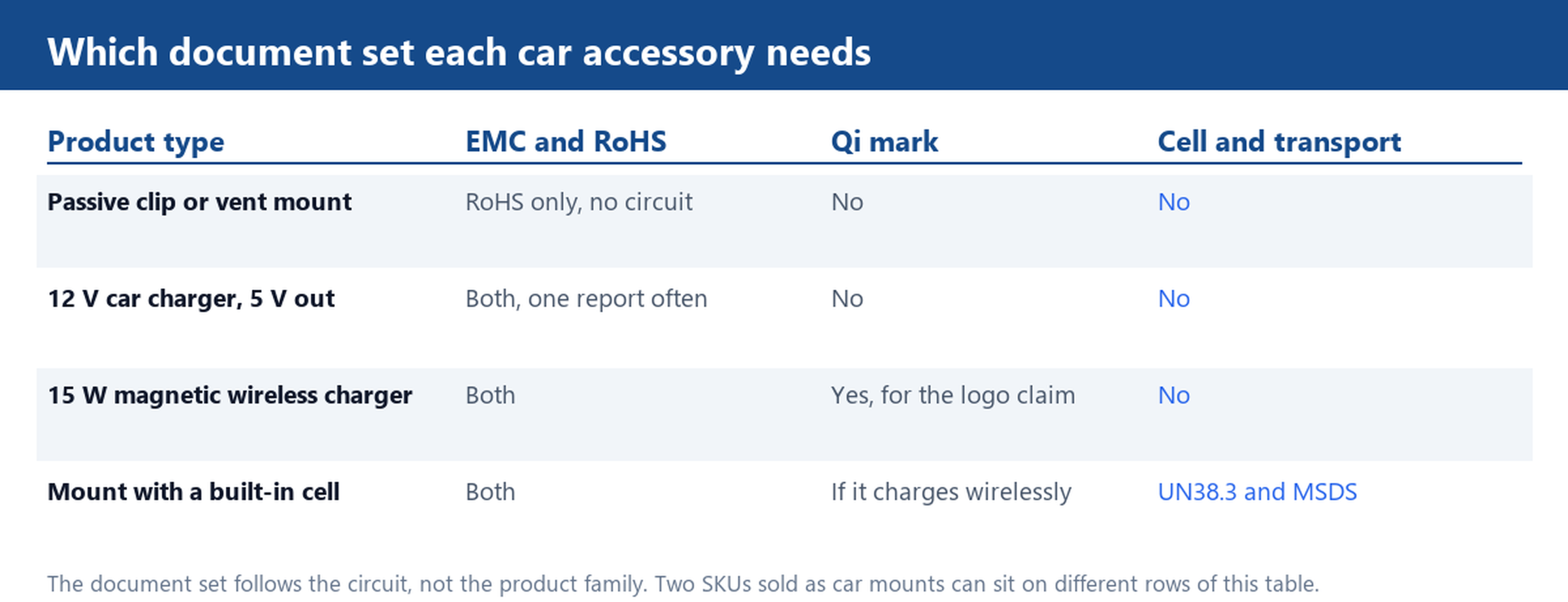
The list follows the circuit, not the product family. A passive vent clip or dashboard bracket is a moulded part with a ball joint and a spring. It has no power input, no radio, no cell and no charging coil, so the document most markets ask for is a RoHS statement covering the materials and the surface finish. Sending a full CE set for a passive mount is not wrong, but it invites a question about which directive was applied to a part that draws no current.
A powered accessory is a different file. The moment a product accepts 12 V from the vehicle socket and outputs 5 V, it contains a switching converter, and that converter is an electromagnetic compatibility question. Add a charging coil and the file gains a wireless power certificate. Add a cell and it gains transport papers as well. A catalogue that groups all of these under car accessories will present them as one family, and the purchase order will ask for one document set. It is worth splitting the SKUs before replying, which is the whole point of the table below.
CE, RoHS and the Difference Between a Declaration and a Test Report
A declaration of conformity is one page, signed by the manufacturer, naming the product, the directives applied and the standards used to demonstrate compliance, and it carries the legal weight of the CE mark. A test report is twenty pages or more, produced by a laboratory, recording the actual unit tested, its serial number, the test methods and the measured results. The declaration says a product complies. The report is the evidence behind that sentence. A supplier who sends only the declaration has given you the claim; a supplier who sends the report has given you the working.
RoHS is a separate instrument from EMC and is often conflated with it. The restriction covers ten substances in electrical and electronic equipment, and evidence usually comes as either a test report on homogeneous materials or a set of supplier material declarations assembled into a technical file. For a passive mount, material declarations are the normal form; for a charger with a PCB, solder and a moulded shell, a lab report on the relevant materials is the more usual ask.
One scope point is worth knowing because it removes an argument. The low voltage directive applies from 50 V AC and 75 V DC upward. A car accessory running from a 12 V socket with a 5 V output sits well below that band, so the low voltage directive is not the instrument behind its CE mark; EMC is, with RoHS alongside. If a document list cites the low voltage directive for a 12 V charger, the list was written for a different product and can be answered that way.
15W Magnetic Wireless: Why a Qi Certificate Sits on Top of CE and RoHS
A 15 W magnetic wireless charger carries two things that a wired charger does not: a coil that transfers power across an air gap, and a magnet array that holds the handset in position. The magnet is a mechanical and material question, covered by the RoHS file. The coil is a wireless power question, and that is where the Qi certificate enters.
Qi certification is issued through the Wireless Power Consortium after testing at an authorised laboratory, and the resulting certificate carries an identifier that can be looked up in the public product database. Two consequences follow. First, the Qi logo may only be applied to a product that holds a valid certificate, so a retail buyer asking for the logo on packaging is asking for the certificate whether or not the email says so. Second, the identifier is checkable in about a minute, which makes it the cheapest verification in the whole file. Ask for that identifier and look it up in the public database, rather than accepting a scan with that field blacked out.
The same logic applies to any wireless claim that names a standard. If the packaging says 15 W and the certificate covers a lower power level, the certificate is the document that decides the argument, not the artwork.
Cell Inside the Accessory: UN38.3, MSDS and the Shipping Paper Trail
A mount or charger with a built-in cell is a lithium battery shipment as well as an accessory, and that adds a document set that has nothing to do with CE. UN38.3 is the transport test regime for lithium cells and batteries, and it consists of eight tests: altitude simulation, thermal cycling, vibration, shock, external short circuit, impact and crush, overcharge, and forced discharge. The document a forwarder actually wants is the test summary, a short extract that names the cell, the test laboratory and the pass results for each of the eight.
Alongside it sits the safety data sheet, in the sixteen-section format used for hazardous materials classification, and usually a battery declaration for air transport. None of these are marketing documents and none can be produced quickly if they were never done. A factory that has shipped lithium products by air before will have them on file in an afternoon. A factory that has only shipped passive parts will not, and the delay will land on your production schedule rather than theirs.
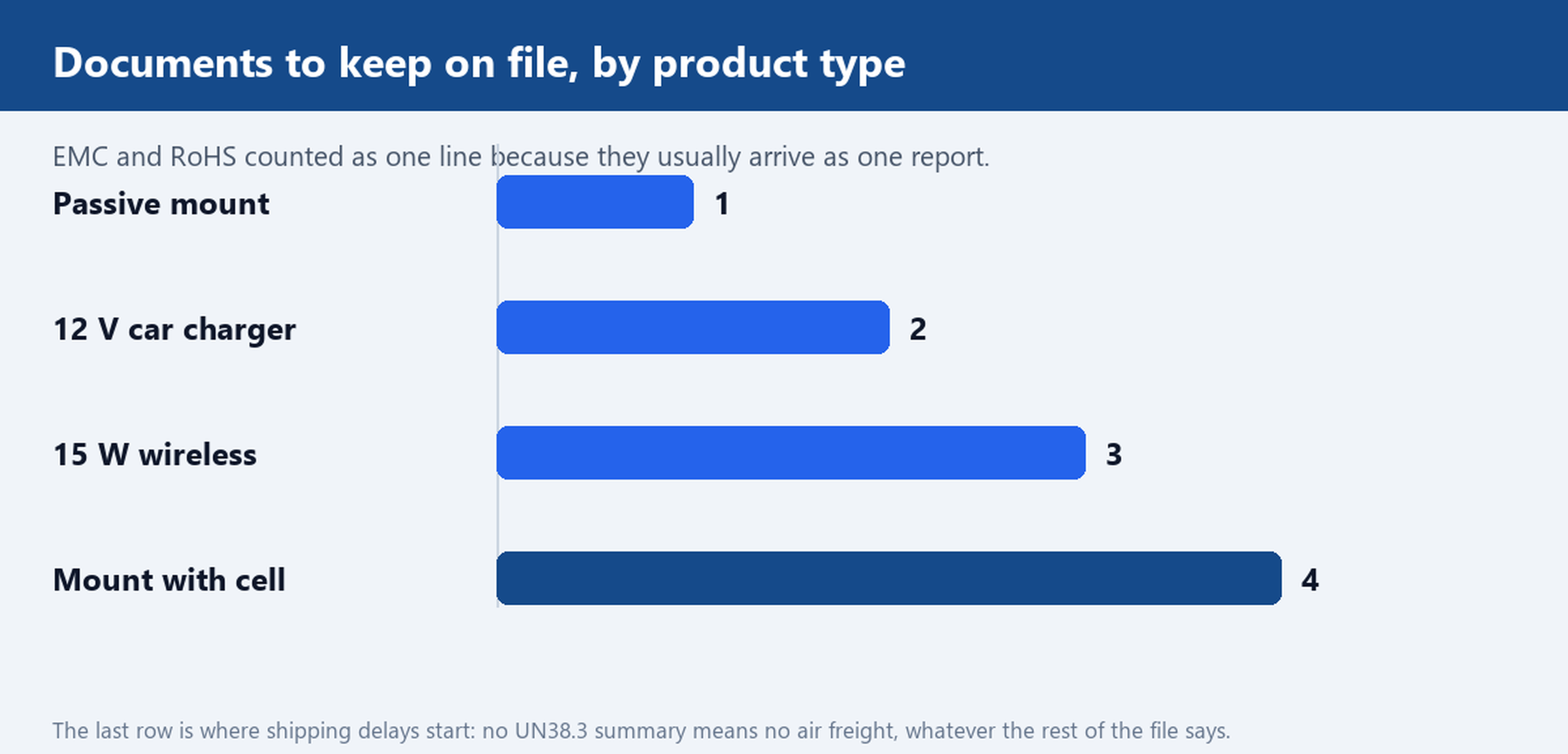
This is the row where the purchase order timeline is decided. A missing EMC report delays a listing. A missing UN38.3 summary delays a container, because the freight forwarder cannot accept the booking without it.
Building the File Before the PO: What to Request From the Factory
Six requests cover the list that most retail buyers send, and asking for them together produces a file that answers the follow-up questions too:
- A signed declaration of conformity per SKU, with the directives and standards named, not a generic company certificate covering a product family.
- The EMC and RoHS test reports behind that declaration, with the model and serial number on the report matching the SKU being ordered.
- The Qi certificate for any wireless charging product, plus the power level the certificate actually covers.
- The UN38.3 test summary and the safety data sheet for any SKU with a cell, including a mount that only charges a phone through its own battery.
- A REACH statement on substances of very high concern, which European retailers ask for on plastics, coatings and printed surfaces even when the product has no electronics.
- The artwork proof for mark placement, because the CE mark, the Qi logo and the crossed-out bin symbol all have minimum size and legibility rules that a packaging designer working from a template will not know.
Two of those six are worth asking for on the sample stage rather than at the order stage: the Qi identifier, because it can be verified in a minute, and the UN38.3 summary, because its absence changes the shipping plan rather than the paperwork. Everything else can follow the quotation.
Tell us the SKU mix in your PO and the destination market, and we will list which documents each item carries before you place the order. The car accessories range includes both passive mounts and powered charging mounts, and the two do not carry the same file, which is the first thing worth settling.
