

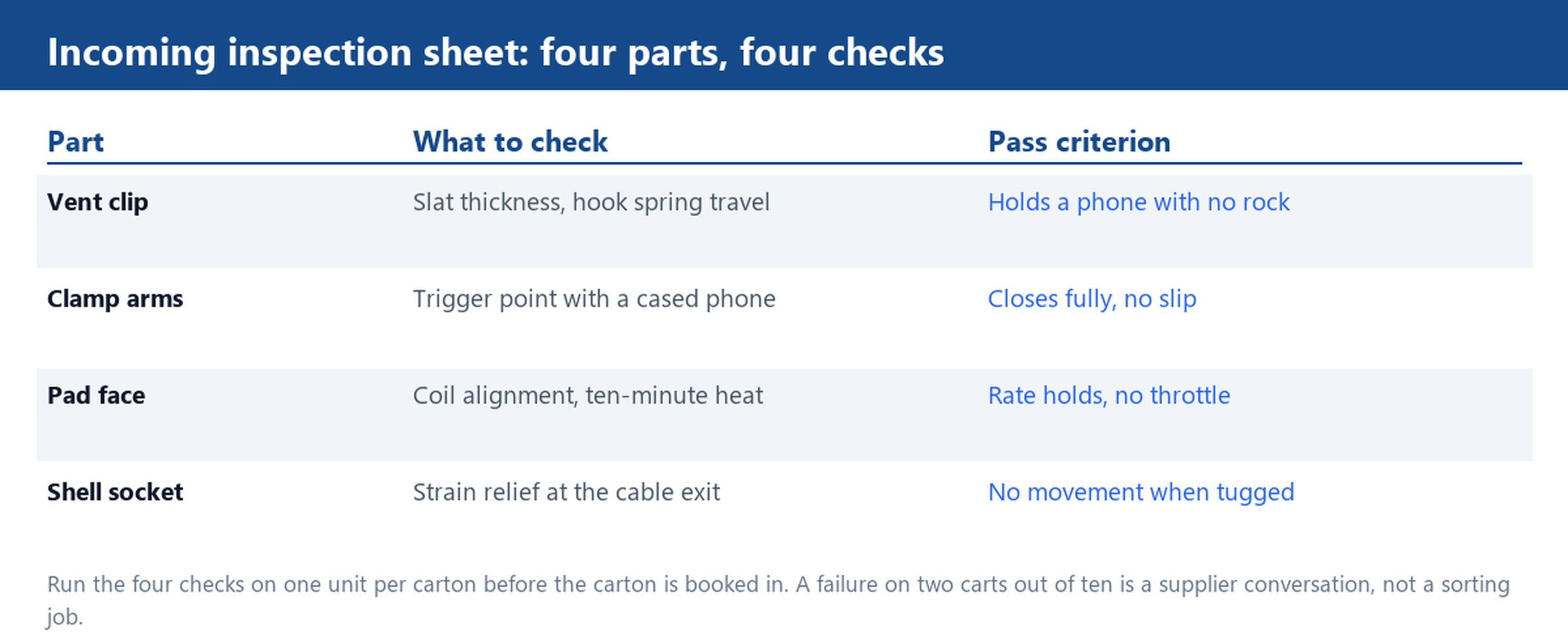
Most returns on a vent-clip car mount are decided in the first thirty seconds of use, not in the first month. The clip either grips the slat or it does not, the arms either close on a cased phone or they stop half way, and the pad either keeps its rate after ten minutes or quietly drops the phone to a trickle. All three are visible at goods-in, on a sample from each carton, without any test equipment beyond a phone and a stopwatch. The question is not whether the mount looks right in a product photo, but how to inspect car accessory stock that arrives in mixed cartons and leaves the warehouse the same week.
Vent-Clip Fit: Slat Thickness and the Angle the Pad Ends Up At
The clip is a hook with a spring behind it, and it is designed around a slat thickness range. Vent slats vary more than buyers expect: a thin blade slat in a compact car and a thick horizontal bar in a van are different parts to grip, and a hook that seats on one slips off the other. Measure the slat thickness and the gap on the vehicle types the order is aimed at, then check that the hook closes with its spring compressed rather than bottoming out on the slat.
The second half of the fit is the angle. On the 15 W sensor mount the clip carries a hinged cradle, so the pad can be tilted towards the driver once the clip is seated. Load the heaviest phone in the range, tilt the assembly to the working angle and tap the top edge of the phone. Movement at the hinge, rather than at the clip, is the failure that shows up later as a phone that faces the floor by the end of a drive.
One more point that never appears on a drawing: the clip must not jam the louver. If the hook sits across the slat travel, the driver loses the vent setting, and that complaint is filed against the mount rather than the car.
Auto-Clamp Arms: Trigger Point, Closure Force and Phone-in-Case Grip
Two mechanisms are sold under the same description, and they fail differently. A sensor mount opens its arms when a phone approaches the pad, so the trigger point matters: a dark or thick case can sit under the sensor threshold and the arms never open, which the driver reads as a dead mount. The spring-loaded version on the auto-clamping vent mount is pushed open by the phone itself, so a thick case needs more insertion force and the arms can close unevenly if one side binds.
Test with the case, not with a bare phone, and use the thickest case in the range. Insert and remove twenty times and watch three things: whether both arms reach the case at the same moment, whether they meet the case back across a broad face rather than pinching the rim, and whether either arm lands on a side button. Arms that grip the rim hold the phone by a few millimetres of plastic and let it pivot; arms with flat inner faces hold the whole back.
Closure force is the number nobody quotes and everybody feels. Too light and the phone slides down the pad when the car goes over a speed bump; too heavy and the arms crush a soft case or fight the driver every time. If a supplier cannot state the force, the sample test is to hold the mount upside down with a phone clamped and shake it gently: a phone that moves has already failed the road test.
The Charging Face: 15W Pad Alignment and Heat After Ten Minutes
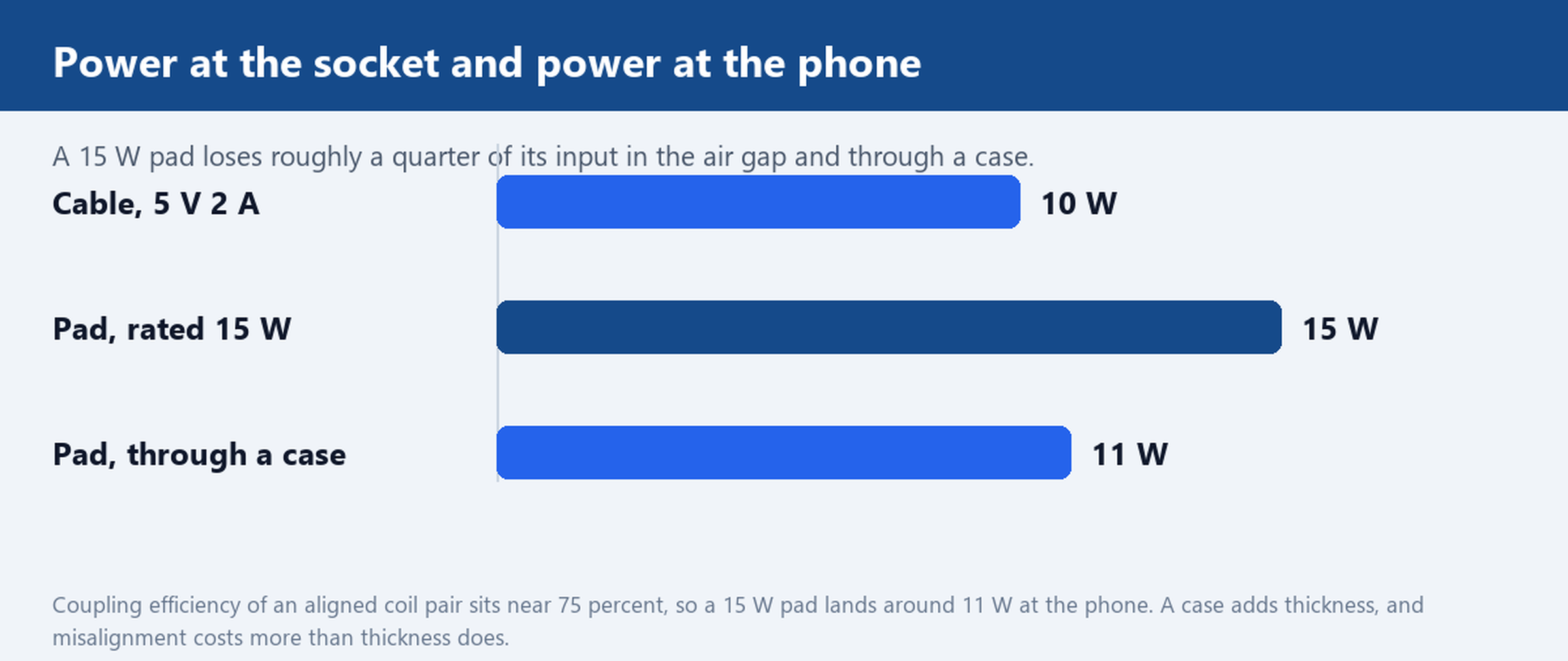
A 15 W rating describes the input to the coil, not the power that reaches the battery. An aligned coil pair couples at roughly 75 percent, so about 11 W arrives at the phone, and the same phone on a 5 V 2 A cable receives 10 W with no coupling loss at all. That gap is why alignment is the whole game on a wireless mount: a phone sitting a few millimetres off centre gives back more than the cable comparison ever offered.
Seat the phone and confirm it sits on the recessed pad rather than on the arms. Then run the ten-minute test: charge from a known percentage, note the rate at minute one and again at minute ten, and feel the pad and the phone back. A pad that is warm is normal. A phone that has dropped to a trickle, or that has shown a temperature warning, is misaligned, sitting too far from the coil because of a thick case, or fed by a mount that cannot hold its input voltage. Check the third possibility by running the same phone on a cable from the same vehicle outlet.
Cable Socket and Strain Relief at the Shell Base
The power socket is recessed into the shell base and takes a short cable from the vehicle outlet, with the line routed below the dash. Two failures belong to this part. The first is retention: pull the cable sideways as it would be pulled by a foot or a bag, and watch whether the plug rocks in the socket or the socket itself pushes into the housing. A loose socket charges intermittently, and intermittent charging is the hardest complaint to reproduce at a support desk.
The second is routing. At 12 V a 15 W pad draws about 1.3 A, which is modest, so the risk is mechanical rather than thermal: a cable that leaves the shell at a sharp angle will fail at the strain relief long before the conductor does. Fit the mount to a vent, route the cable as the customer would, and check that the run to the outlet does not load the socket at an angle.
Carton-Level Checks: Mixed Models, Spares and Labelling
Individual units can pass and a shipment still arrive wrong. Mixed cartons are the usual cause: two mount models with near-identical housings, one with a sensor and one with a spring, counted as one SKU on the packing list. Count by model and colour against the purchase order, and open at least one inner box per model rather than one per carton.
Spares are the quiet line item. Clips break, adhesive pads lose grip and the small parts are what keep a retail account alive between orders, so confirm that the spare clips and mounting pads quoted are actually in the carton and not promised for the next shipment. Labelling is the last check and the one that stops a container at the border: model reference, input rating, the CE mark and the importer details on the retail pack, and a warning line that matches what the unit actually does.
Record the four checks per carton on one sheet and photograph the failures. When two carts out of ten fail the same check, the conversation is with the supplier about the production lot, not with the warehouse about sorting. The car accessories range and the car charger range cover the vent-clip and pad variants described here, with clips and cradles shared across models so a spare part order stays simple.
Send the vent type and phone models you sell to, and we will ship a sample mount with a one-page inspection sheet you can copy for incoming goods.
