

Decorative LED lights are usually judged on how they look in a dark showroom, but an importer should judge them on how a full carton behaves after weeks on a shelf. The returns on 3D night lights and touch desk lamps trace back to a small set of repeatable faults: light that pools behind the engraving instead of spreading, a Micro-USB socket that loosens, a touch pad that fires with no hand near it, a cell that empties ahead of the claim, and a base that never sits flat. This roundup of led product common defects turns those complaints into a short intake checklist that needs only a dark corner, a 5 V supply and a stopwatch.
None of these checks need a light lab, and none of them destroy the sample. Run them in a fixed order on the first three units out of a carton before you release the rest. A unit that fails the light-spread check should still be tested for the socket and the touch pad, because a single carton often carries two faults at once. Record each result against the carton number, so a claim against the factory refers to measurements rather than to a vague impression that the lights look cheap.
Light Output: 0.5 W Into a 5 mm Acrylic Sheet
A 3D night light is a thin acrylic plate, usually about 5 mm thick, lit from an edge by a 0.5 W LED module. The engraved pattern appears to float because light travels inside the sheet and escapes only where the surface has been cut. When the LED sits slightly off centre or the plate has a chamfer that is not even, the light collects in one corner and the far half of the pattern stays dim. That unevenness is a common complaint, and it is obvious the moment the unit is switched on in a dark room. The same construction appears across the LED Products range, so the check transfers from one shape to another.
Check it by powering the sample in the darkest corner available and looking through the face of the plate rather than at it. A good sheet shows an even glow across the whole engraving with no bright wedge at the entry point. Reject any unit where one side is clearly brighter, where a dark band runs through the pattern, or where the colour shifts from one end of the plate to the other, which points to a mismatched LED bin between batches.
The second fault in this section is surface damage. A 5 mm acrylic plate picks up scratches during assembly and packing, and those scratches catch the light as white lines that look like cracks once the unit is on. Wipe the plate with a soft cloth and view it at a shallow angle under a desk lamp before you power it. A scratch that is invisible when off will show up as a bright streak when on, and it is a cosmetic reject that the buyer will notice before the retailer does.
The Micro-USB Socket Is Usually the First Failure
Most decorative lights in this range take 5 V through a Micro-USB socket, and that socket is the weakest mechanical part of the build. The plate is light, so the cable hangs from the connector and lever-loads the solder joints every time someone moves the lamp. After a few weeks the joint cracks or the contacts lose spring tension, and the light either flickers when the lead is nudged or stops coming on until the plug is held at an angle.
Test it by seating the plug fully, switching on, and then gently moving the lead side to side and up and down at the point where it enters the housing. The brightness must stay constant through the whole motion. Any flicker, any drop to a dimmer level, or any need to press the plug inward is a reject, because the same motion happens every time a customer charges the unit. Repeat with a second cable: a fault that follows the lamp is a socket fault, while a fault that follows the cable is a cable fault and should be raised with the accessory supplier instead.
Also check what ships in the box. A 5 V wall adapter and a short Micro-USB lead are normal for the desk lamp versions, while the flat 3D plates often ship with a cable only. Confirm the exact accessory list against the approved sample before the PO, because a missing adapter turns a working lamp into an apparent dead-on-arrival complaint at the retail end.
Touch Switches That Fire on Their Own
Touch desk lamps use a capacitive pad in the base instead of a mechanical switch. The pad reads a change in capacitance when a finger approaches, which means it can also react to a damp cloth, a metal object resting nearby, or a power supply with a noisy output. A unit that changes brightness or colour with nobody touching it will be returned as faulty even though the LED and the cell are fine.
Set a powered unit on a dry table in a normally lit room and leave it untouched for one minute. It must hold its state for the whole minute. Then tap the centre, then tap about 5 mm in from each edge of the pad, then tap with a fingernail and with a fingertip. Every tap should produce a response, and no response should happen without a tap. An edge that never registers points to a pad that is smaller than the printed marking, which is a moulding error rather than a setting error.
Run the same check with the supplied charger plugged in, because some units behave correctly on a cable and misbehave on a wall adapter. If the false triggers appear only when the adapter is connected, the problem is in the power stage and not in the touch firmware, and swapping units at the support desk will not fix the batch.
Battery and Charging on 1,200 mAh Desk Lamps
The cordless touch lamps in this range, including the Night Sleep LED Lamp, carry a 1,200 mAh cell. Capacity is the number buyers compare, so it is also the number most worth checking. Charge a sample fully, switch it on at the setting stated on the listing, and time how long it runs before it drops to the dimmest level. Compare the result with the claim on the page rather than with a number you remember from last season, and write the measured figure into the intake sheet.
Charge time is the other half of the check, and it is simple arithmetic: capacity divided by current. Figure 1 shows the ideal time for a 1,200 mAh cell at three common charge currents, before conversion and cell losses make the real time longer. 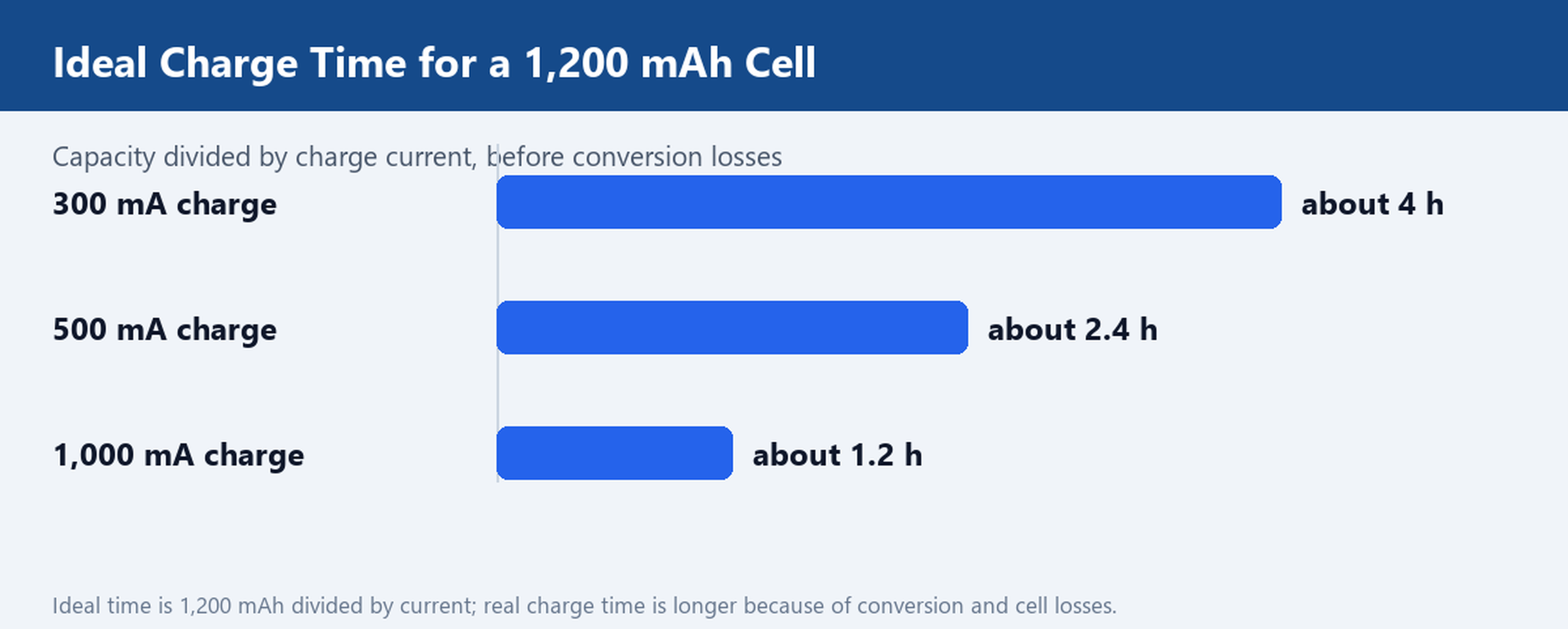
A lamp that takes far longer than the ideal figure is likely on a weak adapter or has a high-resistance charge path, which shows up as a warm socket and a slow rise in brightness during charge. A lamp that reaches full in roughly the ideal time but runs for a fraction of the claimed hours has a cell below its marked capacity, and that is a supplier issue that no amount of support scripting can cover. Test at least three units from different positions in the carton, because a mixed cell lot is a common way for one good sample to hide a weak production run.
A Five-Minute Carton Check Before the Retail PO
Put the seven checks together and a single carton can be screened in a few minutes. The table below lists each fault, the quick check that exposes it and the line at which the unit should be rejected. Keep it beside the intake bench and use the same wording for every shipment, so a dispute with the factory can be settled from the intake sheet rather than from memory.
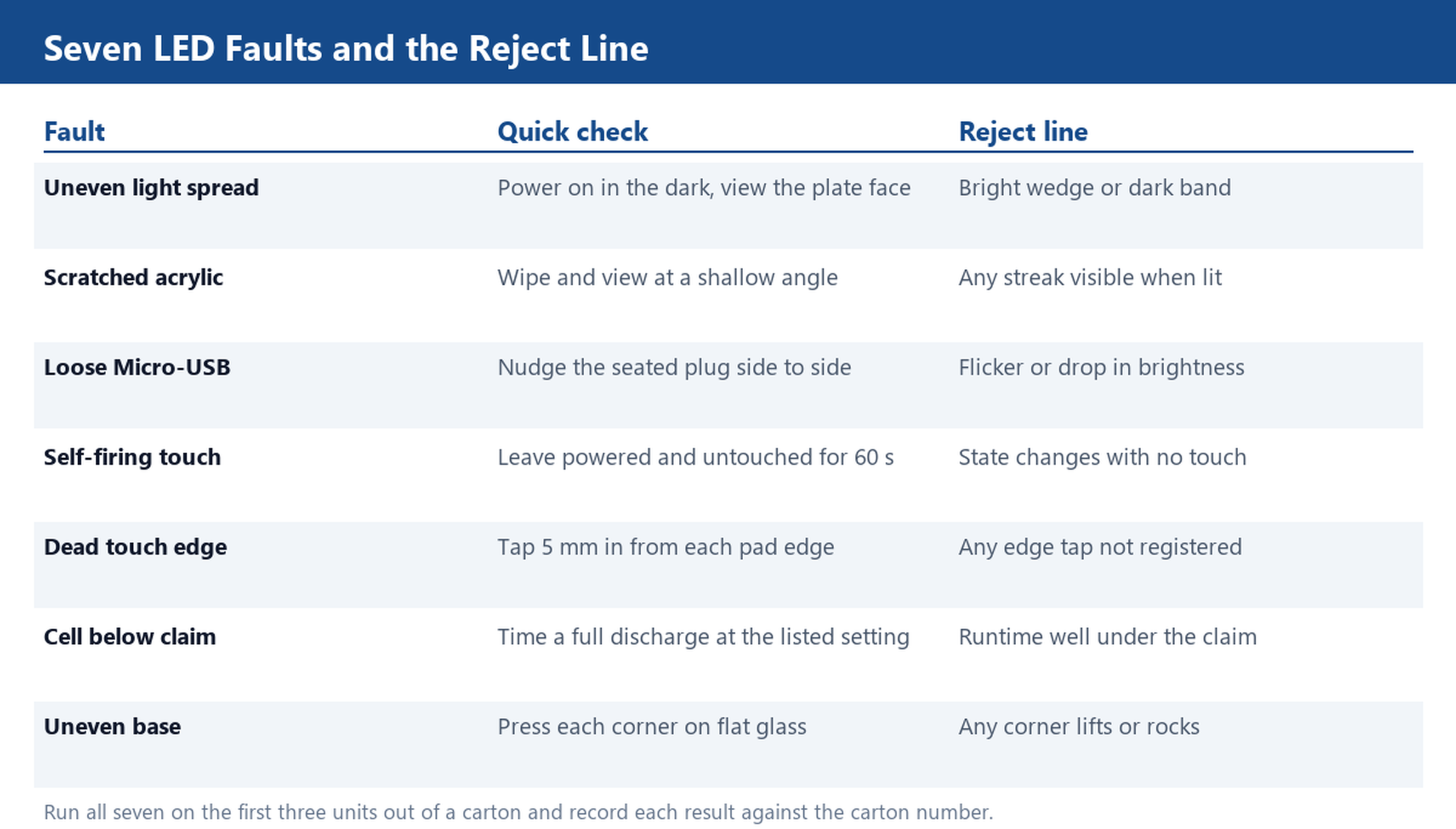
Finish by setting each lamp on a flat sheet of glass and pressing each corner of the base in turn. A base that rocks or lifts a corner will make the touch pad feel unresponsive in use and will leave the plate leaning on a shelf, which customers read as poor build quality even when the electronics are fine. Check that the feet are present and even, and that the packaging holds the plate without letting it rattle against the housing in transit.
Buyers who receive a clean sample and a mixed bulk lot usually discover the difference too late to renegotiate. Send your night light artwork and we will return a defect checklist plus a sample quote, with the power, socket, touch and cell settings written down so the production run matches the unit you approved.
