

Choosing an LED product for home is not a question of which lamp looks good on a shelf. It is a question of which room you are lighting, and what power that room can give you. In the LED range three products solve three different problems: a 0.5 W acrylic night light that only works next to a socket, a touch lamp with a 1200 mAh battery that leaves the nightstand with you, and a 2 W aluminium reading lamp that actually puts light on a page. Match the lamp to the room first and the rest of the buying decision becomes simple. This guide walks through the power figures, the physical limits and the small age-related weak points of each type so you can build one order for three rooms. 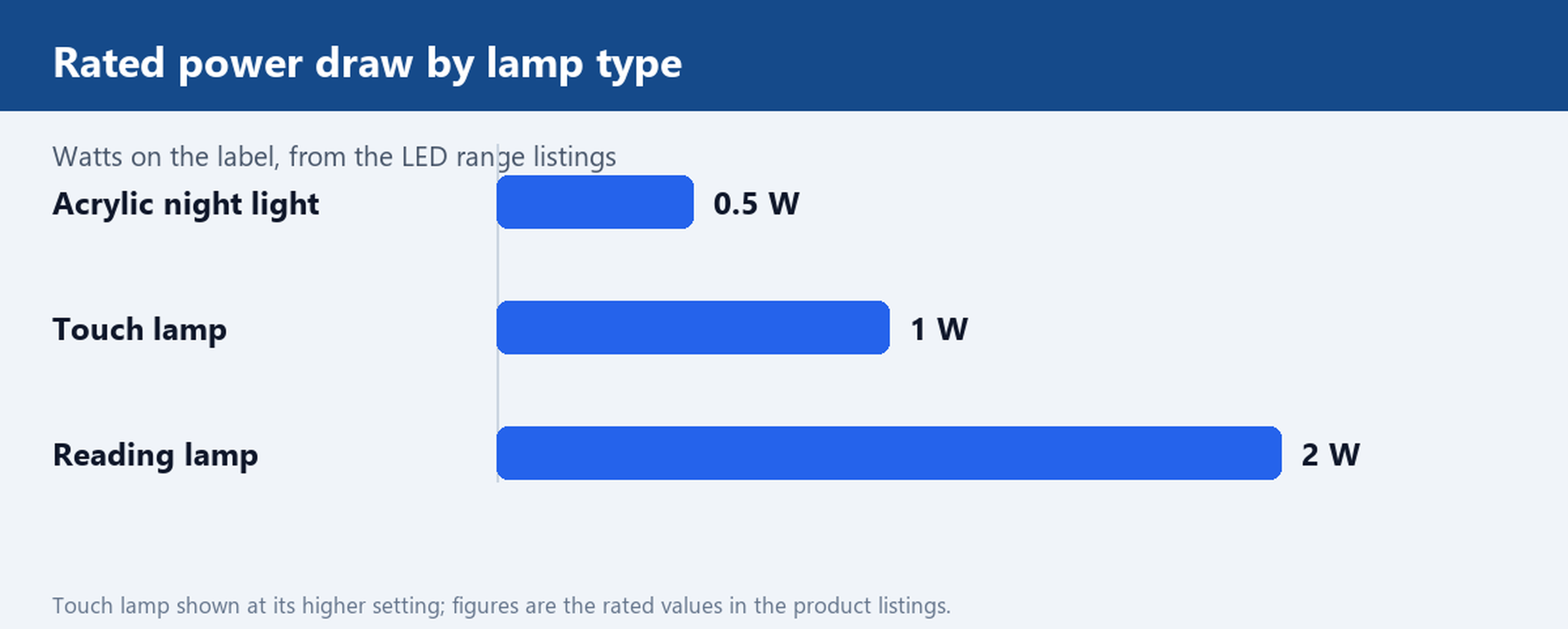
Match the Lamp to the Socket, Not to the Picture
Product photos show a lamp glowing in a dark, staged room. That image hides the single most important variable: where the power comes from. A 3D acrylic night light is rated at 0.5 W, runs on 5 V through a Micro-USB plug and has no battery inside. It cannot be carried from room to room. It is a fixture for a wall outlet, a good fit for a hallway, a stair landing or a child's room where a low, warm glow is enough to find your way without waking anyone. The touch lamp is different. It carries a 1200 mAh 3.7 V cell, so it works until you recharge it and can be picked up and moved. The 2 W reading lamp also carries 1200 mAh but pairs it with a 5 V / 800 mA input and a shaped head, which is what makes it a task light rather than an ambient one. Decide the socket situation of each room before you decide the shape of the lamp. 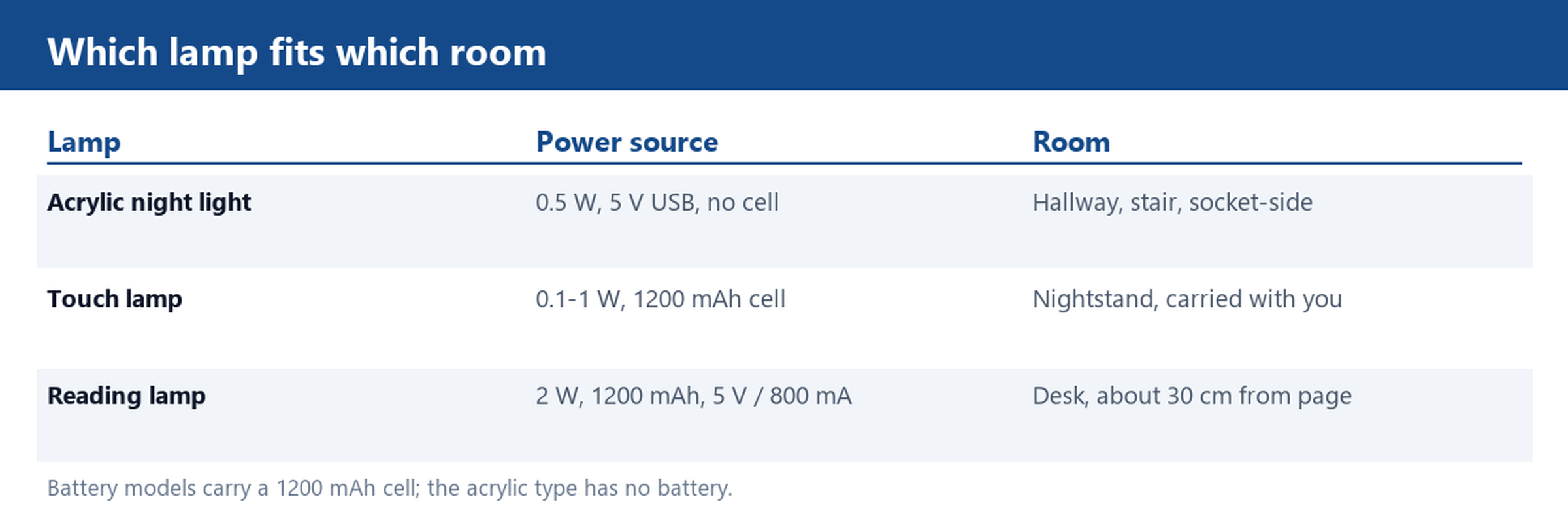
0.5 W Acrylic Night Lights: Where the USB Lead Sets the Limit
At 0.5 W, an acrylic night light draws little enough to run all night from a phone charger or a power bank, but it still needs that lead. There is no internal cell, so the moment you unplug it the light goes out. That constraint actually makes it useful in specific places. A stair landing with a socket near the floor, a bathroom corridor, a shelf in a nursery: these are spots where you want a permanent, low-output glow and never plan to move the lamp. The acrylic panel is thin and diffuses the light softly, and the colour temperature sits in the 2700-3000 K warm band, which is easy on the eyes at night. The trade-off is placement freedom. If the room has no free outlet near the floor or the wall, this type is the wrong choice and a battery model will serve better. Check the socket layout of the room before you order this one.
A 1200 mAh Touch Lamp That Leaves the Nightstand
The touch lamp is the middle option and the most flexible of the three. It runs at roughly 0.1 W to 1 W depending on brightness setting, and it holds a 1200 mAh 3.7 V battery, so a charge lasts through a night and often longer at the dim end. The base measures about 200 x 180 x 85 mm, large enough to be stable on a bedside table but small enough to carry to the sofa or the kitchen when you need it. Tap control means there is no switch to find in the dark. This is the lamp for a bedroom where you read for ten minutes and then want a soft light while you fall asleep, or for a hallway where you take the light with you to the door. Do not expect it to light a whole room; at 1 W it is an ambient source. Its strength is mobility, not output.
2 W Reading Lamps and the 30 cm Luminance Question
A reading lamp has one job: put enough light on the page without throwing it into your eyes. The aluminium reading model is rated at 2 W, carries the same 1200 mAh cell as the touch lamp and takes 5 V / 800 mA to recharge. The useful figure here is the distance between the head and the book, roughly 30 cm in normal use. At that range a 2 W emitter with a shaped shade gives a focused pool of light, which is why this is the one lamp in the group that genuinely works for reading rather than just for orientation. Hold the light closer than 30 cm and the pool shrinks and gets harsh; hold it much farther and the page goes dim. The aluminium body also acts as a heat sink, so the light stays stable during a long reading session. If the main need is a desk or a bedside book, this is the model to lead with.
Colour Temperature, Acrylic Thickness and What Ages First
A few shared details are worth checking across all three types. The acrylic night lights sit in the 2700-3000 K warm range, which suits night-time use and does not disturb sleep the way a cool white source can. A thicker acrylic panel spreads the light more evenly; a very thin one can show bright spots where the LEDs sit behind it. On the battery models, the part that ages first is the cell, not the LED. A 1200 mAh lithium cell will slowly hold less charge as the charge cycles add up, so a lamp that once lasted a full night may need recharging sooner over time. That is normal wear and not a defect, and it is a reason to buy from a supplier who can spare a replacement rather than treating the lamp as disposable. None of these points affect the first week of use, but they matter when you are choosing what to keep in a room long term.
Buying the Set: One Order, Three Rooms
The practical way to buy an LED product for home is to think in rooms rather than in single lamps. Map the rooms: a hallway and a stair landing take acrylic night lights because there is always a socket nearby; the bedroom takes a touch lamp for its 1200 mAh cell and tap control; the desk or reading corner takes the 2 W aluminium lamp. One mixed order covers the whole home and avoids the mistake of buying three of the same lamp and finding that none of them fits the third room. The three products share a warm, low-output character, so the home reads as consistent rather than a patchwork of different colour temperatures. If you are unsure how a mixed sample should look for your room list, send the room list and the socket layout and we will propose a sample mix of night light, touch lamp and reading lamp. You can also reach the contact us page with the room list attached.
