

A 100,000-hour mark on a plug-in night light describes the LED die, not the lamp a customer unplugs and repacks. For a buyer setting a led product lifespan promise, the useful question is which part stops working first. On a 0.5 W acrylic lamp the socket, the 5 V / 1 A adapter and the diffuser age long before the emitter does; on a battery model the 1200 mAh cell and its charge port set the real cycle. This guide reads the rating for what it is, walks through the parts that fail in real use, and turns that into a warranty term a distributor can honour. 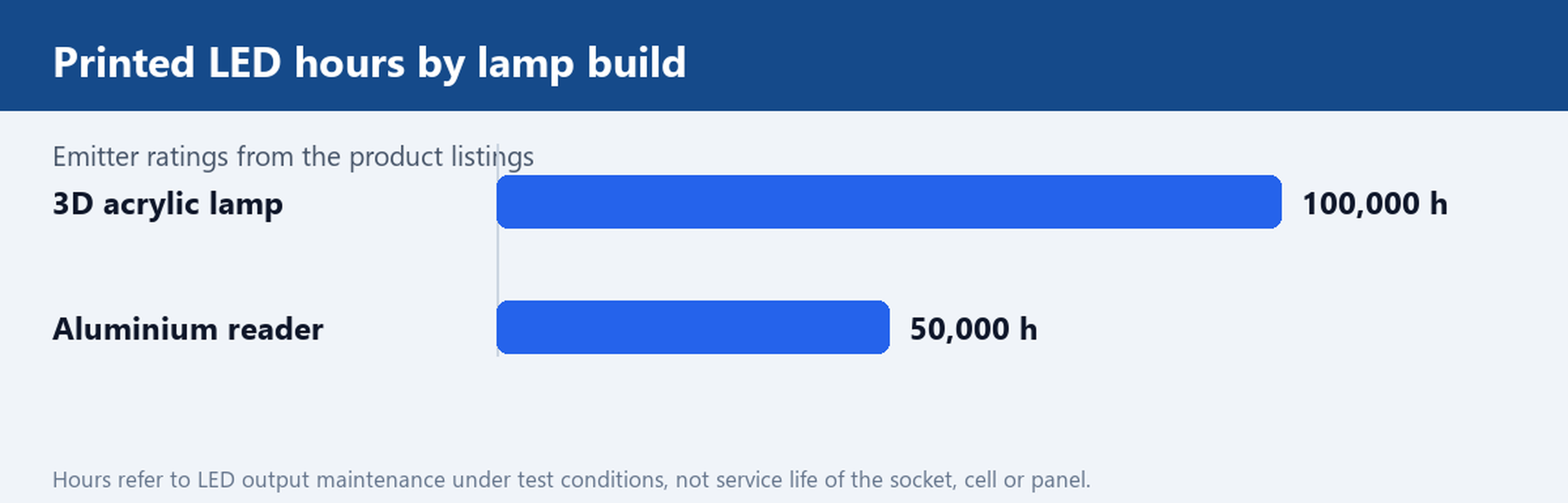
What a 100,000-Hour Rating Actually Measures
An LED rating is a lumen maintenance figure. It says that under a stated drive current and a controlled ambient temperature, the emitter is expected to keep a defined share of its initial output for that many hours. It does not say the lamp switches off at that point, and it does not say anything about the plug, the adapter, the switch gear, the housing or the cell. When a listing prints 100,000 hours for a 3D acrylic lamp and 50,000 hours for an aluminium reading lamp, the difference usually reflects drive conditions and test assumptions, not a promise that one complete lamp lasts twice as long as the other.
That distinction is the starting point for any serious led product lifespan comparison. Ask the supplier what was tested: the bare emitter, the assembled light engine, or the finished lamp. Ask which output threshold was used and at what ambient temperature. If the answer stops at the number on the box, treat the number as a sorting aid for emitters rather than a service-life statement. A buyer who builds a returns budget on the printed figure alone will find the budget wrong in the first season, because the parts that fail are the parts that people touch, bend and charge.
There is a practical reason the industry quotes hours at all. It gives designers a way to compare emitters running at different currents. A die driven gently holds output for longer; the same die pushed hard gives more light and a shorter rating. Neither case tells you how many times a Micro-USB plug can be inserted before the joint cracks. For a reseller, the second question is the one that generates warranty claims, so the rest of this guide follows the physical parts of the lamp instead of the emitter curve.
The Micro-USB Socket: First Failure on a Plug-In Unit
The 0.5 W 3D acrylic night light is a plug-and-play fixture. It runs on 5 V through a Micro-USB socket and has no cell inside, which means the socket carries every insertion and every hour of current. Wear shows up at the solder joint and at the cable exit, not at the LED. The early sign is flicker when the cord is held at a slight angle; the lamp still works when the plug is centred, so a quick bench check can miss it. A buyer checking samples should hold the plug still and gently move the cable through a small arc, then repeat after a dozen insertions. Movement that changes brightness points to a weak joint or a loose strain relief.
The 5 V / 1 A adapter is the next part to audit. It sits behind a bedside table or under a stair landing, often covered by fabric, and it runs warm for hours every night. Heat dries the output capacitor and the case softens; the adapter then supplies a noisy or sagging rail, and the lamp appears to fail even though the emitter is fine. Check the label matches the input the lamp asks for, feel the case after a long run, and confirm the plug does not rock in the socket. A lamp that dims at the end of the night may be seeing a supply problem rather than an ageing LED.
For a programme built around a fixed outlet, stock the adapter and the lead as service items. They cost far less than a whole lamp and they cover the failure mode a customer actually reports. The same advice applies whether the fixture is a plain acrylic panel or a shaped lamp such as the Skull 3D LED Lamp: the emitter rating is shared, the connector wear is local to the installation. 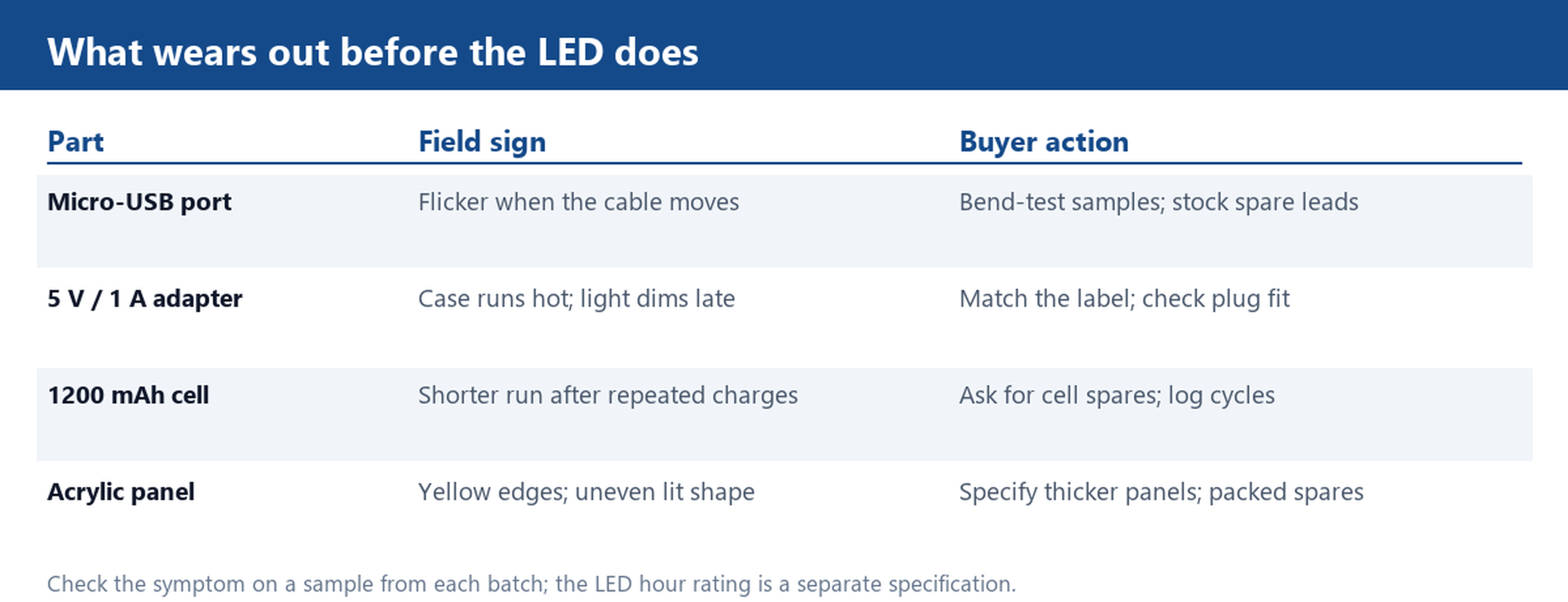
Battery Units: 1200mAh and Which Charge Cycle Ends First
Battery models move the weak point from the mains plug to the cell and its input. The touch lamp and the aluminium reading lamp both use a 1200 mAh cell, and that cell is a consumable. Each charge cycle slowly reduces the charge it can hold, so a lamp that once covered a full night needs a top-up sooner. This is normal cell behaviour, not a defect in the emitter, and it is the most common reason a customer decides a light has worn out. A serious led product lifespan audit therefore tracks charge cycles and runtime, not just brightness.
The charge input fails in a different way. On the reading lamp the input is rated at 5 V / 800 mA; the smaller connector sees repeated plugging, often by a child or in a dark room, and the cable is pulled at an angle. Check that the port sits flush, that the plug clicks in without force, and that the indicator light behaves the same at every charge. Remember that a full battery can hide a weak port for weeks: a lamp charged rarely may look fine while the same model charged nightly is already flickering at the joint.
Ask whether a replacement cell and a replacement lead can be ordered separately, and confirm how the cell is packed for shipping. If the answer is no, plan the warranty around a whole-unit swap rather than a parts repair. The Night Sleep LED Lamp and the 3D LED Lamp suit different rooms, but a buyer sourcing them together should treat the cell and the input as shared wear items. Put the expected cycle pattern in the purchase spec: a bedside lamp charged every night is a different duty from a hallway light left on a mains lead.
Acrylic and Diffuser Ageing on 3D Night Lights
The acrylic panel is the third wear surface. A 3D lamp is sold on the shape it draws in a dark room, so a panel that yellows or clouds changes the product even while the light still works. Warm 2700-3000 K output flatters the panel, but the material itself reacts to heat, sunlight and harsh cleaning. Alcohol wipes and abrasive cloths leave a haze that spreads the beam unevenly, and a thin panel shows bright spots where the LEDs sit behind it. A thicker panel spreads light more evenly and survives more handling.
Judge a sample the way a customer will use it. Wipe the panel with a soft dry cloth, look for edge chips, and check whether the lit shape stays crisp after the panel has been out of its box for a while. Ask the supplier how panels are packed and whether a spare panel is available; a replaceable panel turns a cosmetic complaint into a small parts order. Keep the claim about the printed hours separate from this check. A panel that has discoloured has not exceeded the LED rating, yet the customer will still call it a failed lamp, and that call lands in your returns budget.
Store and display samples away from direct sun if they are meant to demonstrate lifespan to a buyer. Showing a yellowed panel beside a fresh one invites the wrong conclusion about the emitter, while a clean sample lets the conversation stay on the parts that can be specified: panel thickness, diffuser material and the way the base holds the panel upright. Those are the details that belong on a purchase order, alongside the LED hours.
Setting a Warranty Term the Product Can Actually Meet
A warranty built on the printed hours invites disputes. A term built on parts is easier to run. For a plug-in unit, state the period for the adapter and the lead, and describe the flicker test that counts as a fault. For a battery unit, state the period for the cell and the input, and define what a depleted cell looks like after normal nightly charging. Keep cosmetic panel wear in a separate clause with its own remedy. Each clause names the symptom a customer can describe on a returns form, which cuts the argument about whether the LED has reached its rating.
Then run a small ageing check before you commit to a term. Take samples from more than one batch, cycle the plug and the charge port, leave the adapter under its normal load, and record when a symptom appears rather than when the light goes dark. Compare the result with the supplier claim, and write the difference into the purchase spec. Our buying notes on the blog show how a clear remedy reduces friction; the same clarity helps when you set terms for a new model. You can also browse the LED Products range to match a warranty to a specific build.
Tell us the warranty term you plan to offer, and we will match a model and send a sample for your own ageing check. Reach the team through the contact page with the outlet layout, the charge pattern and the term you need to support. That is a more useful starting point than a longer number on a box.
