

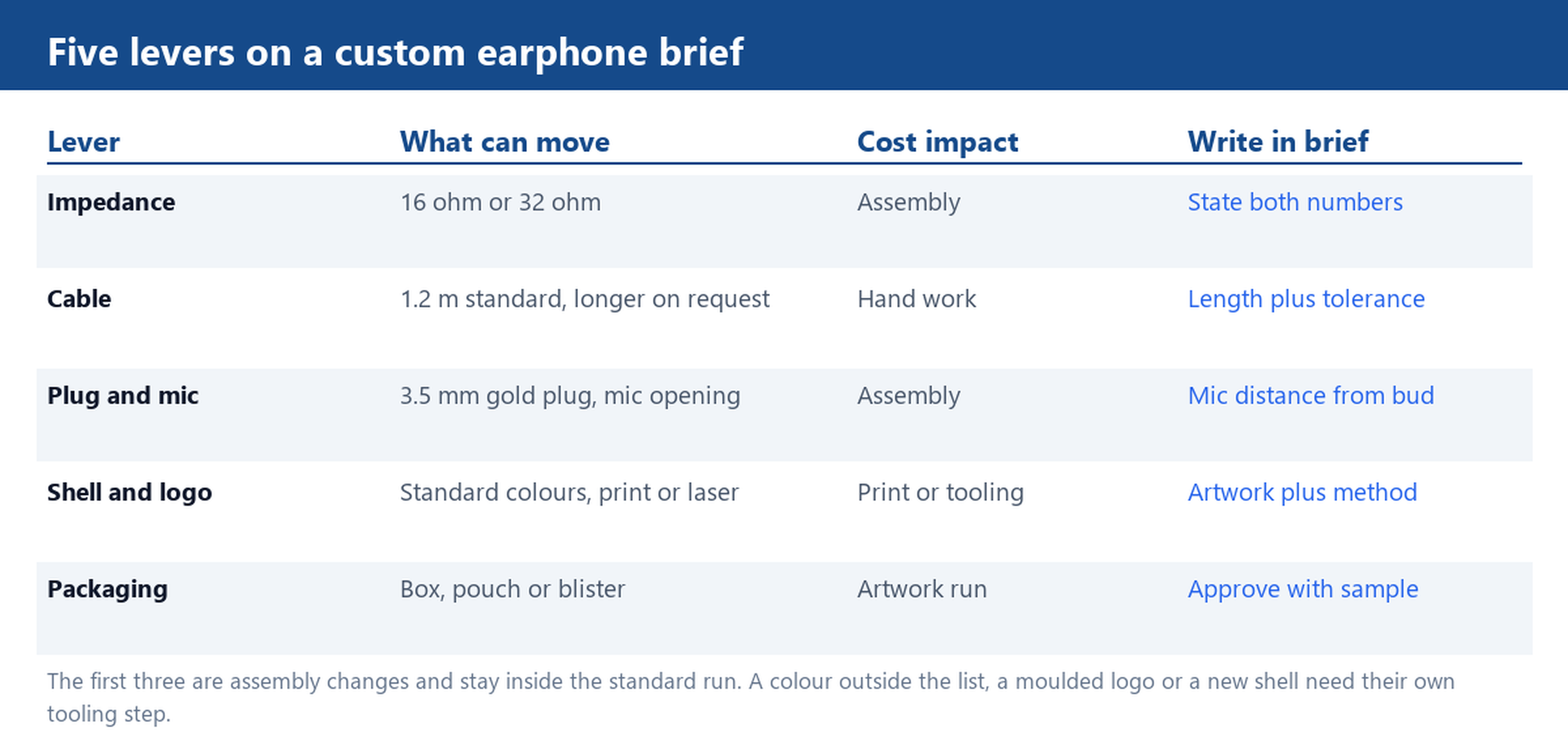
A custom earphone OEM brief is usually longer than it needs to be, because most of what buyers ask for does not change the tooling. Five levers decide almost everything: impedance, cable length, plug and mic, shell colour and logo method, and the packaging that ships with the unit. Everything else is either a variation of those five or a step that moves the order out of the standard run.
What Actually Changes When You Say Custom: Five Levers, Not Fifty
The useful split is between changes that are made at assembly and changes that need new tooling or a new line setting. Assembly changes are cheap and fast: length, colour, logo print, packaging. Tooling changes are the ones that move the price and the calendar, and they are almost always in the shell or the acoustic chamber rather than in the cable.
On the models stocked here, the standard build already covers a wide band: in-ear wired, 3.5 mm plug, 16 ohm plus or minus 10 percent, 20 Hz to 20 kHz, sensitivity around 96 dB, a 10 mm driver, 1.2 m cable, a microphone, and a colour list that runs from beige to yellow. That is why most briefs are answered with a variation of an existing model instead of a new one.
Write the brief in four lines and the quotation comes back faster: what the earphone must do, which of the five levers moves, which lever must stay standard, and the quantity with the channel. The earphone category is the place to start, because the model you pick decides which levers are free and which cost money.
16 Ohm or 32 Ohm: Phone Output, Loudness and the Sensitivity That Comes With It
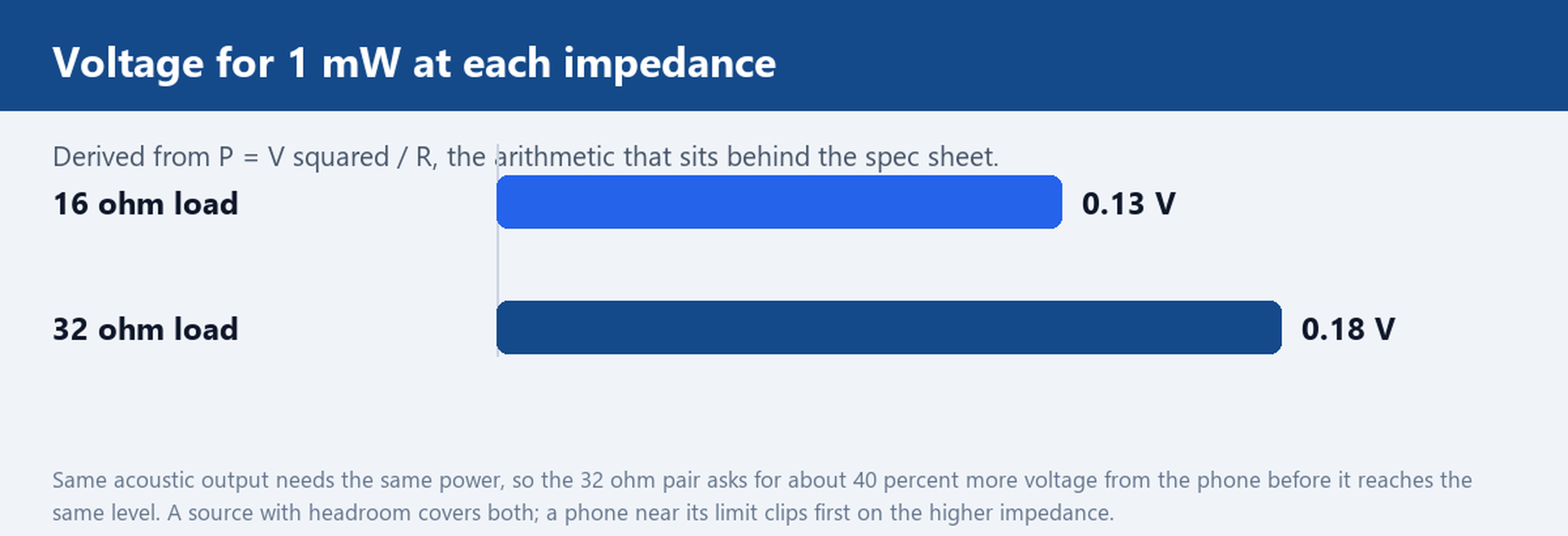
Impedance is the first lever and the one most often specified for the wrong reason. A phone output is a voltage source with a limited supply, so what it delivers into a load depends on the load. At the same sensitivity, a 16 ohm earphone needs less voltage for the same loudness than a 32 ohm one, because power is voltage squared over resistance.
The arithmetic is simple enough to put in the brief. At 1 mW, a 16 ohm load sits at about 0.13 V and a 32 ohm load at about 0.18 V. A phone that can swing 0.5 V has headroom for both, but a phone near its limit with a quiet track will clip first on the 32 ohm pair. That is the practical reason 16 ohm is the default for a phone-first product: it reaches a usable level with less from the source.
The 32 ohm version earns its place when the earphone will be driven by something with more voltage on tap, or when the buyer wants a little more electrical damping and a flatter response away from the resonant peak. It is a different sound character, not a better one, and the sensitivity figure has to be quoted with the impedance or the comparison means nothing. Ask for both numbers on the sample label: 16 ohm at 96 dB and 32 ohm at 96 dB are two different products.
Cable at 1.2 m, Gold-Plated 3.5 mm Plug and the Inline Mic Opening
1.2 m is the standard length on the wired models here, and it is standard for a reason: it reaches from a pocket to an ear with slack for a turn of the head, and it does not tangle into a bag the way a longer cable does. Changes to this lever are cheap at assembly and expensive in consistency, because a non-standard length is cut and terminated by hand on a short run.
The plug is where most of the perceived quality lives. Gold plating on a 3.5 mm plug is specified for corrosion resistance at the contact, not for sound, and it is worth having on a product that will live in a bag. Check the strain relief as well as the plating: a moulded boot that is too stiff concentrates the bend at one point and the conductor breaks there, months after the goods are accepted.
The mic opening is the detail that decides whether the product is usable for calls. Its position has to sit near the mouth when the cable hangs naturally, which means the distance from the right bud rather than from the plug. Ask for the mic position as a measurement on the drawing, and test a call on a sample at walking speed, because wind noise at the opening is the complaint that shows up in reviews rather than in inspection.
Shell Colour, Logo Method and the Packaging That Ships With It
Colour is the cheapest customisation and the most visible. The standard colour list on these models is wide, and picking from it costs nothing beyond a minimum quantity per colour. A colour outside the list means a paint or masterbatch run, which is a different conversation.
Logo method is the lever that surprises buyers. Pad printing is the lowest cost and works on a flat area; laser marking is permanent and reads well on darker shells; moulded-in logos need a tool change and belong to a volume order. Ask for the logo artwork in vector form and a photo of a marked sample, because a logo that is 2 mm smaller than planned looks like a defect at retail.
Packaging is a spec, not an afterthought: a printed box, a pouch with a logo, or a blister that hangs on a peg each need their own artwork approval. Ship one packaging sample with the earphone sample and approve them together, otherwise the box arrives after the units and the order sits in the warehouse.
MOQ, Samples and the One-Year Warranty Line in the PO
Every one of the five levers has an MOQ step attached, and the steps are not the same: a colour from the standard list has the lowest, a logo print sits above it, and a tooling change sits above that. The quotation should show the MOQ next to each lever rather than one number for the whole order, so the buyer can see which change is actually moving the threshold.
Samples are where the brief is proved. Ask for the sample in the final colour and with the final logo, not a plain unit, and test the three things that cannot be inspected in a photo: the fit in the ear, the mic on a call, and the plug in a pocket. A sample that passes those three is a sample that can be approved.
Finally, get the warranty line into the purchase order itself. The wired models here carry a one-year warranty, and the wording should state what is covered: driver failure and cable break are the two claims that actually arrive. A warranty sentence in an email thread is not a term of the order, and the difference matters at the first claim.
Send a photo of the earphone you want to match and we will confirm impedance, cable length and logo method before quoting.
