

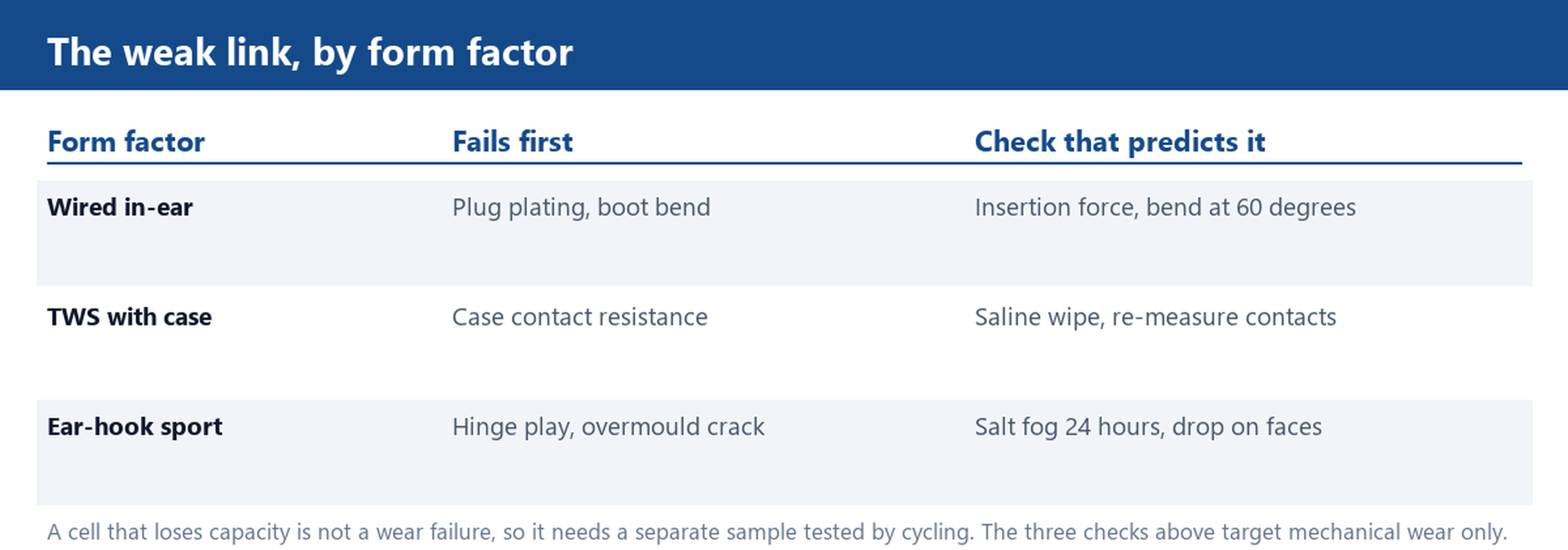
Earphone lifespan is not one number, because the three common form factors fail at different places. On a wired model the plug and its strain relief take almost all of the abuse, and the driver rarely fails at all. On a TWS pair the charging case contacts and the cell inside each bud set the end of life long before the speaker does. On an ear-hook sport model the hinge and the overmould decide, because sweat and salt attack both. Knowing which part is the weak link is what turns a return rate into an incoming inspection item.
What actually sets lifespan: cable, cell or housing
Start by separating the parts that wear from the parts that age. Cable, plug, hinge and case contacts wear: they see mechanical cycles, and their failure is a mechanical event that can be reproduced in a fixture. Cells age: capacity falls with every full cycle and with time spent at a high state of charge, and no amount of careful handling reverses it. Housings do both, because a soft-touch coating can harden under UV while the shell around it also takes drops.
The distinction matters for purchasing, because the two failure families are caught by different tests. Wear is caught by cycling a sample until it fails and then counting the cycles. Ageing is caught by charging and discharging a small sample on an accelerated schedule, or by storing a set at elevated temperature and re-measuring capacity. A supplier who can describe both test setups is usually a supplier who has thought about the return rate.
The practical consequence is that a specification written as one lifespan figure hides the real risk. A model rated for a long time in a drawer and a model rated for the same time in daily commute use are different products, and the difference is almost always in the wear parts rather than the electronics.
Wired models: plug and strain relief take the load
On a wired earphone, the 3.5 mm plug is the highest-stress component. The tip and ring contacts are sprung, and every insertion pushes them against the jack barrel; over a few thousand cycles the plating wears thin at the contact line and the signal starts to crackle when the plug is rotated. That crackle is the classic first symptom, and it appears well before any conductor inside the cable breaks.
The strain relief is the second failure point, and it fails for a predictable reason. Bending concentrates where the flexible boot meets the rigid plug body, so a cable that is repeatedly coiled tight around a phone develops a break a few millimetres behind the boot. The jacket stays intact and the conductors inside part one by one, which is why a channel drops out rather than the earphone dying outright.
Two checks predict both failures. Measure insertion and extraction force with a gauge on new samples and after a few hundred cycles; a force curve that has collapsed means the spring has lost tension. Then run a bend test at the plug exit, cycling to 60 degrees and listening for dropout rather than looking for a visible break, because the electrical failure comes first. The wired in-ear headset format shows how the boot and the plug body are joined, and that joint is where the test should focus.
One design detail is worth writing into a purchase order: whether the plug body is moulded over the boot or whether the boot is a separate moulding. A moulded assembly distributes bending over a longer section and fails later, and it is also harder to repair, which is the trade-off buyers accept on disposable products.
TWS: charging case contacts and cell ageing
A TWS pair has two failure clocks running at once. The first is the contact set inside the case: two or three sprung pins per bud, usually gold flashed over nickel, that mate with pads on the bud every time it is dropped in. Sweat, skin oil and pocket lint collect on those pads, and the contact resistance rises until the case either fails to start a charge or charges intermittently. A bud that reports 100 percent in the case and dies after twenty minutes is usually a contact problem, not a cell problem.
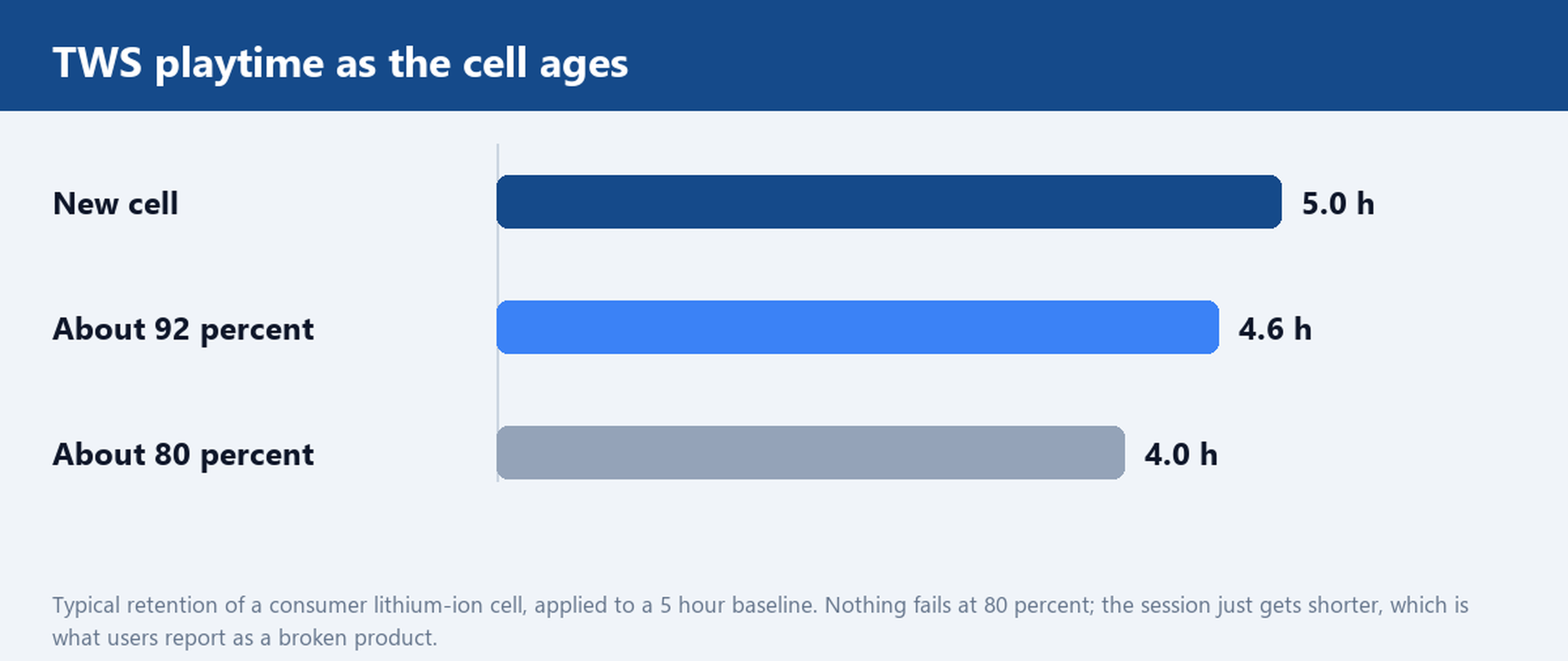
The second clock is the cell. Each bud carries a small cell, commonly in the tens of milliamps-hour, and the case carries a larger one to recharge them. Consumer lithium-ion cells typically hold a few hundred full cycles before capacity falls to about 80 percent of the initial figure, and the visible symptom is not a failure but a shorter session. A bud that used to run five hours and now runs four has lost a fifth of its usable energy, and users report that as a broken product even though everything still works.
Heat accelerates both problems. Charging in a closed car on a summer day puts the case well above room temperature, and a cell stored at high state of charge in that condition ages faster than one cycled gently. The buying decision that follows is simple: ask what state of charge the units ship at and how the case behaves when it is left on a charger overnight, because those two answers describe most of the field ageing.
Ear-hook sport models: sweat, salt and hinge wear
The ear-hook form adds a hinge or a flexible arm, and that mechanical element is the weak link. Every time the hook is opened to put the unit on, the plastic or the metal slider takes a small amount of wear, and the overmould around it flexes. Once the overmould hardens, which it does faster under UV and repeated cleaning with alcohol, cracks start at the highest-stress point and sweat gets inside.
Sweat is not water. It is mildly acidic, typically in the pH 4.5 to 6.5 range, and it carries salt, so it attacks plated contacts and some stainless alloys in a way that a plain water splash does not. An IPX rating describes water ingress, not salt corrosion, and a unit can pass an IPX7 immersion test and still corrode at the charge contacts within a season of gym use. That gap is where a large share of sport-model returns originates.
The check that catches it is a salt fog exposure on a small sample, run for 24 hours and followed by a contact resistance measurement and a visual inspection of the hinge. It is a standard test method used across hardware categories, and it costs a day. Pair it with a hinge cycle test, opening and closing the hook while watching for play, because a hinge that develops side-to-side movement will eventually crack the housing around it.
Incoming checks that predict field returns
Four checks cover most of the risk across the three form factors, and each one targets a specific failure rather than general quality. Run them on a sample from the production lot, not on the golden sample that was approved at the start of the project.
Plug force and bend. On wired models, measure insertion and extraction force, then bend at the boot for a fixed number of cycles and listen for dropout. Record the force before and after; a fall of more than a third is a warning sign even if the audio still works.
Contact resistance in the case. On TWS models, measure resistance across each charging contact before and after a contamination cycle that includes a wipe with a saline solution. A rise that pushes the contact into the hundreds of milliohms will show up as intermittent charging in the field.
Capacity retention on a small sample. Cycle a handful of units and re-measure runtime. Two or three units are enough to see whether the cell behaves like the specification or like a cheaper substitute, and the runtime figure is what the customer will complain about.
Salt fog and hinge play. On ear-hook models, expose a sample for 24 hours, then inspect the contacts and the hinge. Combine that with a drop test on all faces, because a hook that survives sweat but cracks on the first drop has simply moved its failure point.
Write the results into the specification as test methods rather than promises: bend angle and cycle count, salt fog duration, contact resistance limit, and the capacity retention figure after a stated number of cycles. A line that says long life cannot be inspected. A line that says bend 60 degrees for a stated cycle count with no dropout can. That is the difference between a return rate you can manage and one you discover at the end of a season, and the earphone range is organised so the form factor and the wear part can be matched before an order is placed. The wireless earphone with charging case and the PC headset lines cover the two ends of that spread, and the wider audio and video catalogue shows where the same wear parts reappear on other products.
Tell us which form factor you are comparing and the return reason you see most often. We will share the failure points we check on each one and send a sample for your own bend, salt and capacity tests.
