

Opening one earphone page with a single SKU in mind gets harder in 2026. A 3.5 mm wired in-ear set with a 120 cm cord and a 96 dB sensitivity figure sits beside a 40mAh single-bud Bluetooth model, and beside an open-clip pair whose charging case carries a 400mAh cell. Those are three answers to three buying questions, not a ladder where the last row cancels the first. This page treats the earphone new model trend as a spec exercise: what the fit actually changes, what the stated hours cover, which buyers still write a 3.5 mm line into a purchase order, and which fields belong on the order sheet before cartons are sealed. Every figure quoted here is one that a supplier can print on a spec line and a buyer can check on a sample. Where a value has not been stated, it stays a blank field rather than a guessed number. The Earphones category is the starting point for the three formats discussed below.
Three Form Factors on One Price List: Wired, Single Bud, Open-Clip
Start with what arrives in the box. The wired in-ear style headset is a cord product: a 1.2 m lead, a 3.5 mm plug and a stated 96 dB figure. There is no cell, no pairing step and no charging cable in that carton, which is why the line stays in the Audio / Video and Earphones ranges for buyers supplying desks, counters and demo units. The single-bud Bluetooth route removes the cord but adds a 40mAh cell in the bud and a charging case; TWS Bluetooth Wireless Earbuds and Stereo Sound Wireless Earphone with Charging Case sit on that side of the list. The Earphone with Clip and Case is the third shape: an open-clip wear with a 400mAh case cell. A buyer building one catalogue page should keep three separate spec blocks, because sensitivity in dB, bud capacity in mAh and case capacity in mAh answer different questions and cannot be merged into one headline number.
What the Open-Clip Fit Changes: Canal Open, Arm Behind the Pinna
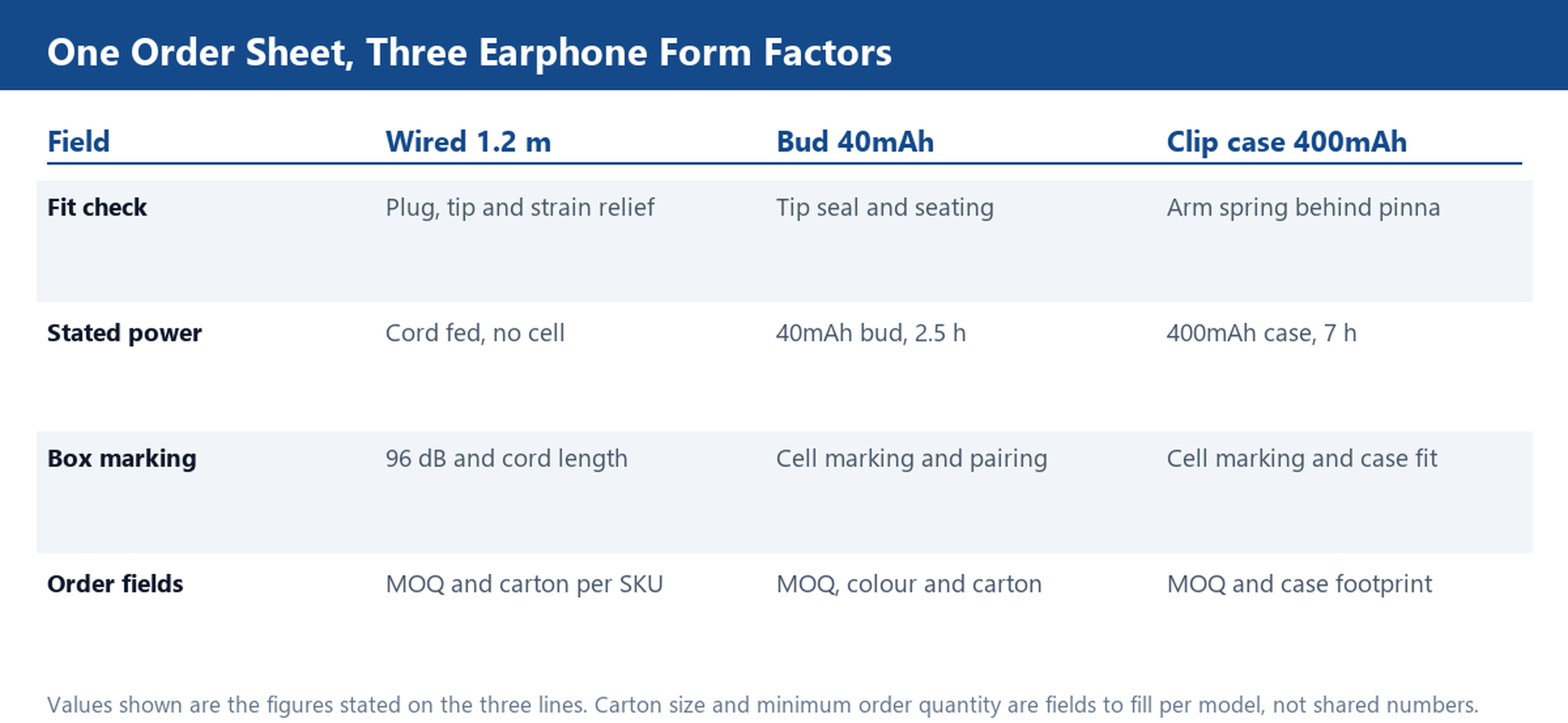
The open-clip format is often described simply as a clip, but the geometry is the part a buyer has to check. The canal stays open, so ambient sound is not blocked by a silicone tip, and the arm rests behind the pinna instead of pressing into the ear. That changes the sample check. On a wired in-ear set the check is plug fit, tip size and strain relief at the housing. On a sealed bud the check is tip seal and whether the bud stays seated when the wearer turns their head. On an open-clip set the check is the arm spring and the contact point behind the ear, with the case lid closed over the arms after a full day of handling. None of these checks needs a laboratory. They need a written line on the inspection sheet and a sample from the same production lot as the order. Ask for the clip shape and the case outline to be confirmed on the drawing before samples are cut, because a case that fits a sealed bud may not close over a clip arm. Buyers who sell into counter environments, where a wearer has to hear a caller at the till, usually shortlist this shape alongside the wired line rather than treating it as a direct swap for a sealed bud.
Runtime and Case Math: 2.5 Hours on 40mAh vs 7 Hours on a 400mAh Case
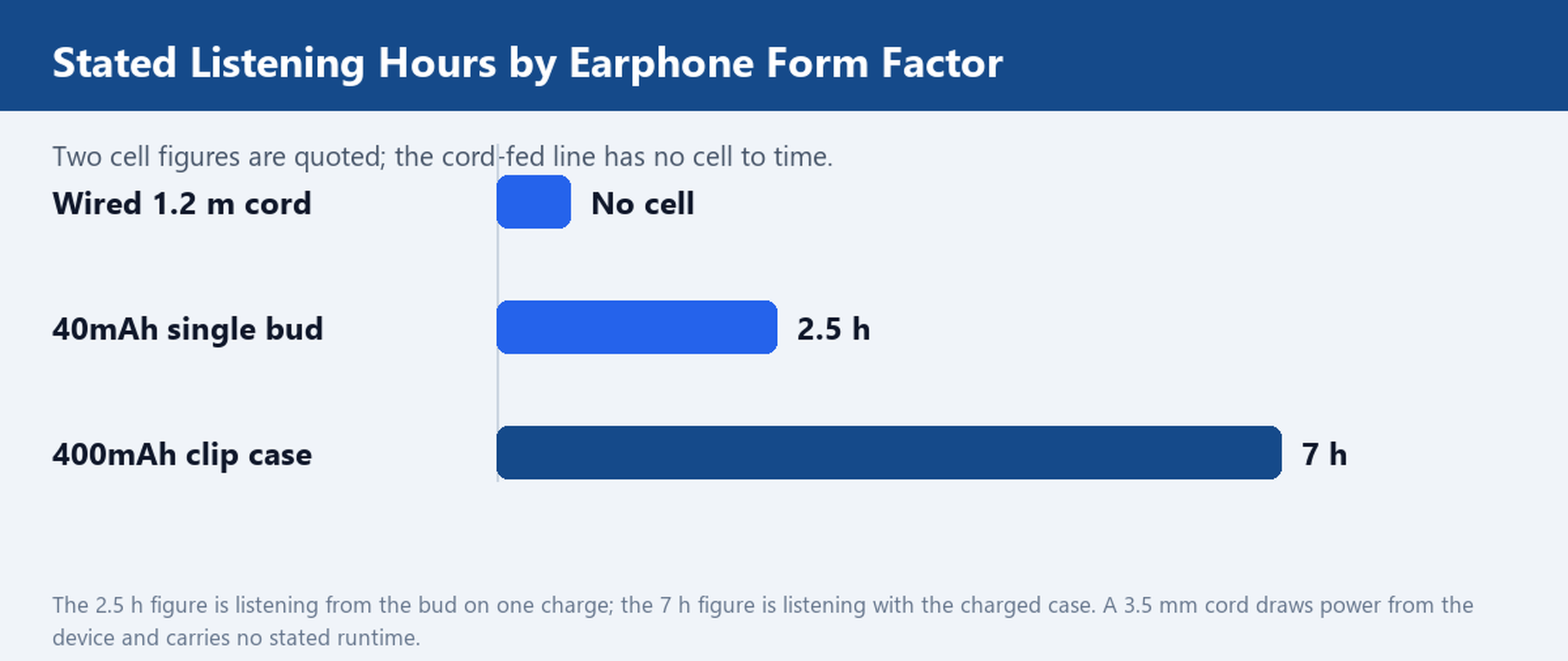
Runtime claims are where two correct numbers can still mislead. The 40mAh single-bud model is stated at 2.5 hours of listening from the bud; the 400mAh open-clip case is stated at 7 hours of listening with the charged case in the set. Those figures are not the same measurement. One describes a single charge on the worn unit, the other describes a session that draws on the case as well. A spec line that prints only 7 hours next to a bud-only photograph invites a returns conversation later, so require the label to say which state was measured. The wired set is simpler: a 120 cm cord draws power from the device, so no playback figure belongs on its line at all.
compares the two stated listening figures and leaves the cord-fed row without a cell to time. When a supplier quotes a new figure, ask whether it was measured at the stated volume with the case included, and write the answer into the spec sheet rather than relying on the marketing copy.
The 3.5 mm Question: Which Buyers Still Order a 120 cm Cord
A 3.5 mm plug is not a legacy accident; it is a requirement on specific orders. Desks with existing monitors, audio interfaces and labelled socket strips still expose a jack, and a wired headset with a 96 dB driver and a 1.2 m lead plugs in without an account, a pairing step or a charge cycle. Counter and demonstration units follow the same logic: a corded sample works when a customer picks it up, and the length is long enough to reach a till or a bench. Newer models do not remove that demand; they sit next to it. The practical question is how the two are written on one order sheet. Keep the wired quantity, cord length and plug variant in their own line, and keep the Bluetooth quantity, cell capacity and case marking in another. Ask whether the plug is plated, whether the lead exits straight or at an angle, and whether the 96 dB figure is printed on the retail box. Those are answerable questions with short answers, and each one removes a reason for a shipment to be held at inspection.
Order Sheet: Carton Size, MOQ and Certification Across the Three Lines
The last block is administrative, but it is where a mixed earphone order usually stalls. Give each form factor its own row. For carton size, record the measured carton for that SKU rather than copying the figure from a different line, because a clip case changes the pack footprint. For minimum order quantity, ask the supplier to state the number per model and per colour, and write it next to the model name. For certification, list the document titles that apply to the destination market and request the numbered copy for review; do not assume a document held for a wired headset covers a cell-powered case. Cell-powered lines also need the outer box marking checked, and the clip line needs the case closure checked after handling. Once those fields are filled, order a sample pair of two different form factors and run the checks described above on both. More buying notes are collected on the blog. Send your market and target retail price, and we will quote the wired, single-bud and open-clip models with free samples of two form factors.
