

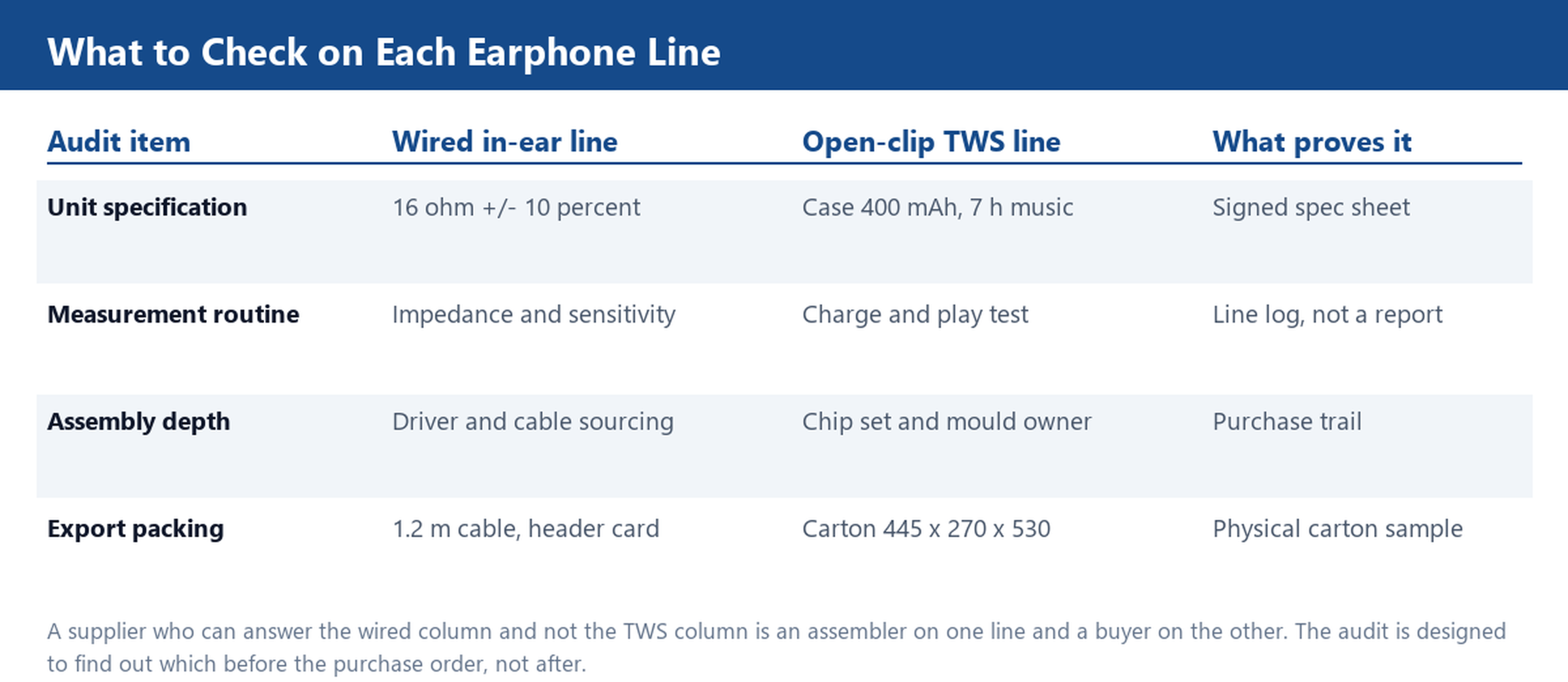
An enquiry to an earphone wholesale supplier usually carries both kinds of product on one sheet: a wired in-ear line and an open-clip TWS line. Most suppliers answer half of it, because the two products are made by two different processes with two different sets of equipment, and only a factory that runs both can be audited on both. The audit that follows is built around that split. It checks four items on each line, asks for evidence that a trading company cannot produce, and ends with the questions that separate an assembler from a maker. Run it before the sample stage, and the answer tells you whether to put the whole mix with one supplier or split it between two.
Two Lines, Two Audits: Why the Quote Covers Half the Order
A wired earphone is an acoustic assembly. The work is driver seating, cable termination, soldering or crimping at the plug, and a strain relief that survives being pulled out of a phone by the cable. The equipment is small: a driver press, a soldering station, a pull tester, an impedance meter and a listening bench. A TWS earphone is an electronics assembly with a plastic and battery content. The work is board population, antenna tuning, battery pack assembly, case moulding and a pairing test that has to run against a phone rather than a signal generator.
Those two processes share a building more easily than they share a quality system. A factory that is strong on one is often a buyer on the other: it sources finished TWS units, prints the box and ships them under its own model number. That is a legitimate business, but it changes what the audit can confirm. On a bought-in line the supplier cannot tell you which chip set is inside a future batch, cannot change the mould, and cannot commit to a driver change without going back to the source.
So the first question of the audit is not about price or capacity. It is which lines are run in-house and which are traded, asked once per product type, and answered with a video walk-through rather than a catalogue page. Ask to see the line running the model you are quoting, not a line running something similar.
Wired Line Checks: 16 Ohm, 96 dB and a 1.2 m Cable
The published specification for a wired in-ear model is the audit script. A representative sheet reads 16 ohm plus or minus 10 percent impedance, 96 plus or minus 3 dB sensitivity, 20 Hz to 20 kHz, distortion at or under 5 percent, maximum input 100 mW, 1.2 m cable and a gold-plated 3.5 mm plug. Each of those figures implies a measurement, and the audit question is whether the measurement happens per unit, per batch or not at all.
Impedance is the one that tells you most, because it is cheap to measure and it drifts with driver seating. A line that checks impedance on every unit has a meter at the station and a log beside it. A line that checks one unit per hundred has neither, and the tolerance in the catalogue is then a statement about the driver supplier rather than about the product that ships. Ask to see the log for the previous week and count the entries against the production quantity.
Sensitivity is the second tell. A 96 dB figure with a tolerance of 3 dB is a wide window, and a line that has no test box cannot tell where inside that window a given unit sits. Listening tests are not a substitute: the auditor cannot hear a 3 dB difference reliably, and neither can the operator at the end of a shift.
Cable and plug quality is mechanical and can be checked by hand in five minutes. Pull the cable at the plug and at the earpiece, look for a moulded strain relief rather than a shrink sleeve, and confirm the cable length is measured from the plug body rather than from the splitter. A 1.2 m claim that includes the plug and the splitter is a shorter cable than the buyer expects.
TWS Line Checks: 400 mAh Case, 7-Hour Claim and the Chip Set
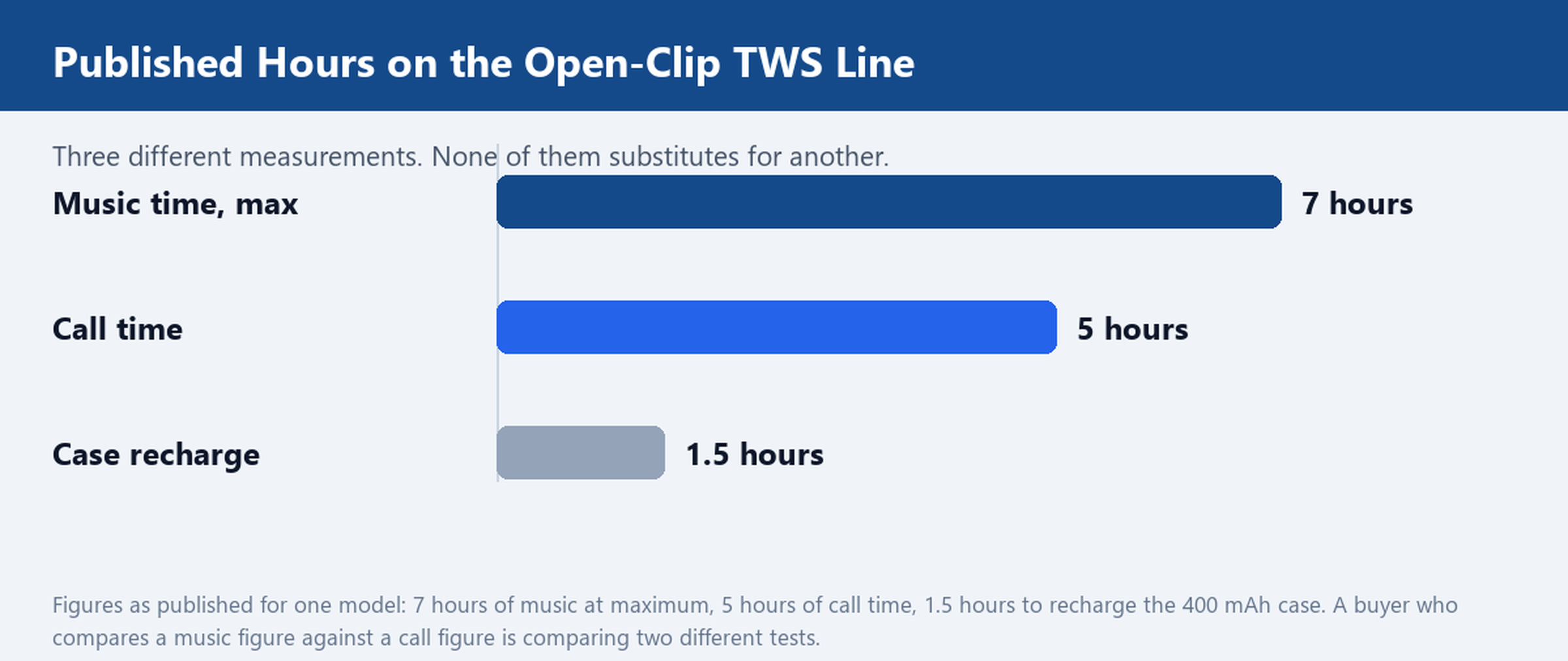
The TWS side is audited through the case and the board. A representative open-clip model publishes a 400 mAh lithium-polymer charging case measuring 71.22 x 67.63 x 29.57 mm, about 1.5 hours to recharge, 7 hours of music at maximum and 5 hours of call time. Those four numbers are the audit script again, and each of them is produced by a different test: capacity by a discharge test on the case, recharge time by a timed charge, music time by a playback run, call time by a radio link held open.
The chip set question matters more than the model number. When the published specification names a specific Bluetooth chip, a buyer can ask whether that chip is fixed for the life of the project or whether it is whatever is available at the time of the run. A chip substitution changes the radio behaviour, the pairing routine and often the firmware tool, and it is invisible from the outside of a sealed bud. Get the answer in writing, with a clause that no chip change happens without a new sample.
Then ask about the mould. A factory that owns the case tool can change a clip arm, a lid snap or a charging port opening. A factory that buys finished cases cannot, and any request for a change becomes a new model rather than a modification. Ownership of the tool is a single question with a binary answer, and it decides whether a private-label programme is possible at all.
Carton, Certificates and the Paperwork Trail
Export packing is where a good product becomes a bad shipment. The published carton for the open-clip model is 445 x 270 x 530 mm, and that number is worth more than it looks: it sets the volumetric weight, the pallet pattern and how many units fit a container. Ask for the quantity per carton and the gross weight alongside it, and ask for a physical carton rather than a drawing, because the inner tray is what actually protects the buds and the tray is usually the part that gets changed without telling anyone.
The paperwork trail is shorter than buyers expect and easier to fake than they think. The marks a wholesale channel asks for are the ones on the model sheet, typically CE, RoHS and FCC, and the audit question is whether a test report exists per model or one report is being reused across a family. Ask for the report that names the model you are buying. A report for a similar model is a claim about a different product.
Two more documents belong in the same folder: a material declaration for the plastics and the battery, and a packaging artwork file that matches the carton you were shown. If the artwork file does not exist, the carton in the photograph was bought from somebody else.
Questions That Separate an Assembler From a Maker
Five questions do most of the work, and none of them can be answered well by a trading company under pressure.
Where does the driver come from, and can it be changed? A maker names the driver supplier and knows the alternatives. An assembler names a model number and hopes the question ends there. The same question applies to the cell inside the charging case: a 400 mAh pack is a commodity, and the grade of that commodity is what sets the failure rate after a year.
Who owns the mould, and can I see the tool? Ownership decides whether a clip arm can be modified, whether a logo can be moulded in rather than printed, and whether a second source is even possible. A maker will show a tool photo with the cavity number. An assembler will change the subject.
What happens at the end of the warranty? Ask for the failure rate the factory accepts as normal, and for what it does when a batch exceeds it. A supplier who answers with a replacement policy has thought about it. A supplier who answers with a promise has not.
How is the line measured, and who signs the log? This is the question that finds the difference between a system and a story. Ask to see a signed log page from last week, on both lines.
Can I ship a sample from each line before the bulk order? A maker will ship two samples from two lines without much argument. An assembler will ship one, because the other line is not in the building.
How to Run the Audit in One Day
The audit does not need a week. Book a video walk-through first and ask for the two lines in one continuous shot, with the model you are quoting visible on the bench. That single recording answers the in-house question before anybody travels.
Then order samples from both lines, one unit per model in the mix, and test them against the published figures rather than against each other: impedance on the wired unit, case capacity and recharge time on the TWS unit, and a fit check on the clip arm. Record the results against the model sheet. Where a figure is inside the published tolerance, the line is doing what it claims; where it is outside, the claim was never true.
The third step is commercial: ask for the carton for each model and a written statement of which lines are in-house. With those three items in hand, the decision to split the order between two suppliers or keep it with one becomes an arithmetic question rather than a relationship question.
The earphone range is organised so that both product types can be sampled from one enquiry, and the PC headset line follows the same audit logic with a different measurement set. Where the mix extends into other categories, the audio and video section and the full product list are the places to build the model sheet from, and the contact page is where a walk-through gets booked.
Send us your earphone mix with expected quantities per model, and we will book a video factory walk-through of both lines and ship sample units from each before you place a bulk order.
