

Search for earphone common defects and you will usually get a list of symptoms: one channel goes quiet, the lead fails near the plug, or the front cover lifts. Symptoms help, but a buyer needs the cause on the production side before the next purchase order is signed. This article follows three returns that repeat in wired models: a worn 3.5 mm plug plating layer, a 1.2 m lead that breaks at the split, and a shell bond that opens. Each section gives a field sign, a spec to check, and a line to put in the PO. 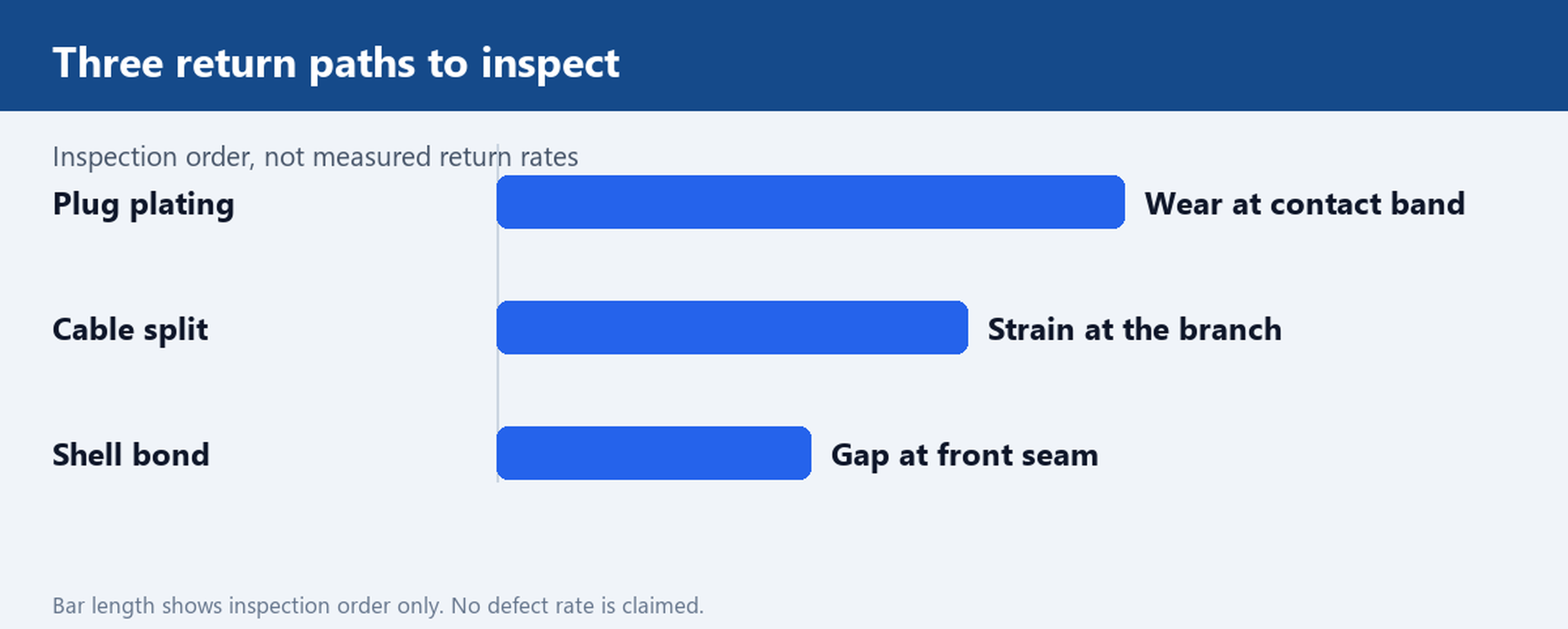
Three Returns That Repeat: Plug, Cable Break and Shell Bond
Returns arrive with short notes. A trading company writes intermittent sound. An online seller writes dead on arrival after two weeks. A distributor sends back a bag of units and asks whether the assembly line changed. In our experience the note rarely names the part, yet the unit itself usually points to one of three places: the contact surface of the plug, the point where the two branches of the lead meet, or the seam where the front shell meets the body.
These are different failures and they need different answers. A plug contact problem is a finish and tolerance question. A lead break is a strain question. An opened shell is a bonding and clip-fit question. Treating all three as one quality problem leads to a broad complaint and a vague reply, which is why the same return comes back on the next order. The practical fix is to separate them at the receiving check, record which part failed, and send that record to the supplier with the unit.
The specs used below come from models in our range, so the numbers are checkable rather than illustrative. One wired in-ear model pairs a 10 mm driver with 16 Ohm impedance at ±10 percent, 96 ±2 dB sensitivity, a 1.2 m lead and a gold-plated 3.5 mm plug. Another wired build uses 32 Ohm and 98 dB with a metal shell. A light plastic model weighs 20 g and is offered in 15 colors with CE, RoHS and FCC documentation and a one-year warranty. None of these figures proves that a model will survive any given use; they define what a buyer can inspect and what a purchase order can hold us to.
Plug Plating: What a 3.5 mm Gold Layer Wears Through
The gold on a 3.5 mm plug is a thin plating over a base contact, not a solid gold part. It exists to keep the contact surface clean as the plug slides in and out of a socket. Wear shows up as dark patches or a dull band across the tip and sleeve. The field sign is intermittent sound that returns when the plug is held at a slight angle. Users often describe it as a loose socket, but the socket is not always at fault.
Two things make this worse. First, a rough base finish means the plating sits on peaks and wears through at those peaks sooner. Second, a plug that is a fraction too small wobbles in the socket, and each small movement rubs the same band. Neither issue is visible in a product photo, so a visual check at receiving should include the plug surface under a light, plus a simple listening check while the plug is gently moved. Do not count mating cycles you have not measured; record what you see and hear instead.
For a 16 Ohm build such as the model with the 10 mm driver, low impedance also makes contact noise easier to notice, because small changes in contact resistance are audible against a low baseline. That is not a defect by itself; it is a reason to inspect plating and fit more carefully on this spec. If a project calls for a metal-shell 32 Ohm and 98 dB build, ask for the plug finish on that model as well rather than assuming it matches the plastic one.
A useful PO line is short: specify the plug as gold-plated 3.5 mm, state that the base contact finish must be smooth before plating, and require a sample plug to be checked for visible wear after your own agreed handling test. Agree the handling steps with us first so that both sides run the same check. A plating claim without an inspection method is just a word on a sheet.
The 1.2 m Lead: Where Strain Lands and How It Shows in the Field
The second repeat return is a lead that fails near the split, where the single cable becomes two branches. The 1.2 m length on our wired in-ear model is chosen for desk and daily carry use, but length is not the cause of the break. The cause is strain concentrated at a point that bends often. Users pull the cable from the case by the branch, wrap it tightly around a phone, or leave it bent inside a bag pocket. The branch junction takes that motion every time.
In the field the sign is a channel that cuts out when the lead is held near the splitter, then comes back when it is released. Sometimes the sound changes with a small twist rather than stopping outright. A receiving check can reproduce this without special instruments: play a steady tone, hold the lead just below the split, and bend gently in the same direction a few times while listening. Record whether the change appears at the junction or further down the branch. That distinction tells you whether to look at the split or at the cable route.
Ask about the strain relief at the split, not only about the cable jacket. A relief that ends too abruptly creates a hard edge, and the conductor flexes at that edge. A relief that is too soft lets the bend reach the solder joint. Both are assembly details that can be corrected once the failing point is identified. We can adjust the relief and the internal anchor on the 16 Ohm, 1.2 m build when the PO states which point must be checked.
Put the method into the order as an acceptance line: name the 1.2 m lead, name the split area as the check point, and attach your bend steps as an agreed procedure. Avoid inventing a cycle count in the contract unless both sides can run that count on the same rig. A repeatable small test at receiving catches more than a large number written on paper and run differently by each warehouse.
Shell Bonding: Glue Lines, Clip Fit and the 20 g Plastic Body
The third return is an opened front shell. On the light plastic model that weighs 20 g and comes in 15 colors, the housing is light enough that a clip can feel secure in the hand yet still open under a small, sustained push at the seam. The failure is rarely a missing bead of glue. More often the glue line is uneven, or the clip on one side sits proud and lifts the seam until the bond has fully set.
The field sign is a visible gap at the front edge, sometimes with the driver sounding slightly hollow because the shell no longer closes evenly. Check the seam all the way around under a light, then press gently at the point where the two halves meet. Look at the clip line as well: a clip that catches on one side only will open the opposite seam over time. Color variants can behave differently if a mating part is changed between runs, so inspect more than one color when a mixed order ships.
This model is documented with CE, RoHS and FCC material and a one-year warranty, but those documents do not describe the bond line. Ask for the bonding check as a separate item. A practical acceptance line is that the front seam stays closed under your agreed press check and that no gap is visible at the clip side. If your market needs a different color mix, ask us to confirm the same clip fit on those parts before the order is locked.
Shell returns are often reported as cosmetic, then turn into functional complaints once moisture or pocket lint reaches the driver. Recording the seam position on each returned unit makes the pattern clear within one shipment. It also lets us trace the issue to a specific assembly step instead of changing the whole housing.
Writing It Into a PO: Acceptance Lines That Catch These Three
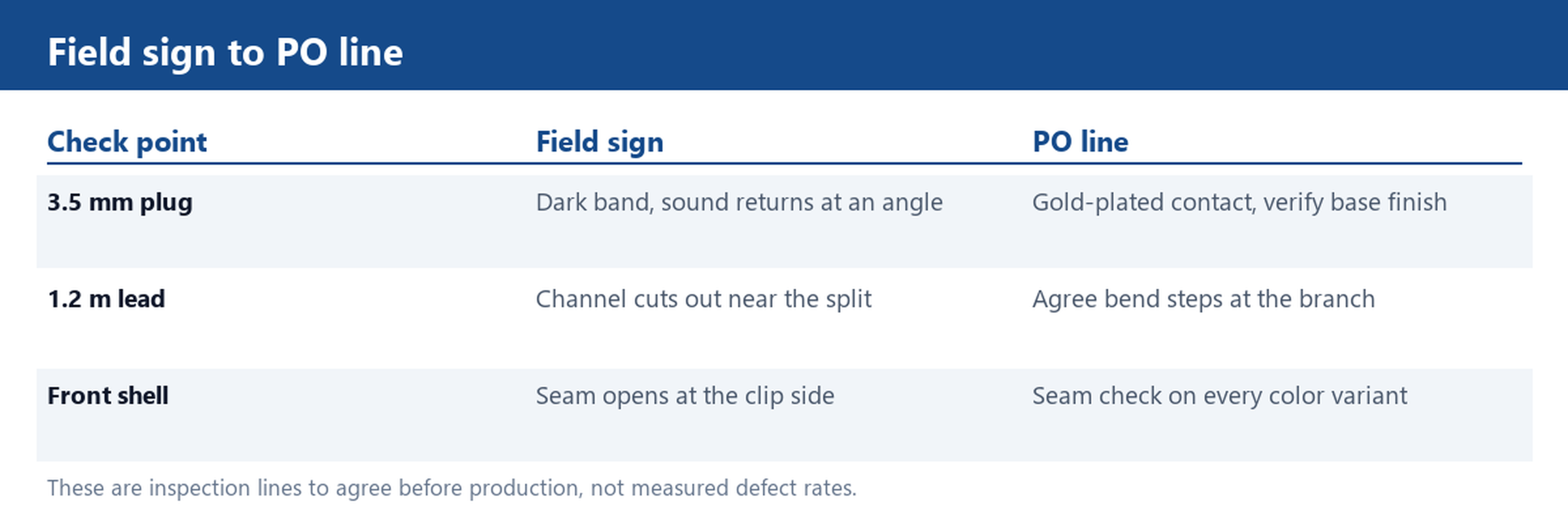
A purchase order does not need to be long to be useful. It needs three named check points and one named method for each. For the plug: gold-plated 3.5 mm contact, smooth base finish, visible wear check after an agreed handling step. For the lead: 1.2 m length, split area as the flex point, an agreed bend procedure with a listen check. For the shell: the 20 g plastic body or the metal-shell variant as specified, a seam check at the clip side, and confirmation that color changes keep the same clip fit.
Keep the method with the order. A photo of the plug band, a short clip of the split-area bend check, and a picture of the front seam give your warehouse and our line the same reference. When a return still arrives, send the unit with the note. We will separate plug, lead and shell causes, then quote the matching 16 Ohm or 32 Ohm build and ship free samples for a re-check.
Earphone common defects are easier to discuss as three checkable places than as one complaint about quality. Plug plating, the 1.2 m lead at the split, and the shell bond each have a field sign you can record and a line you can write into the next order. Send your return reasons or one failed unit, and we will quote the matching 16 Ohm or 32 Ohm build and ship free samples for a re-check.
